
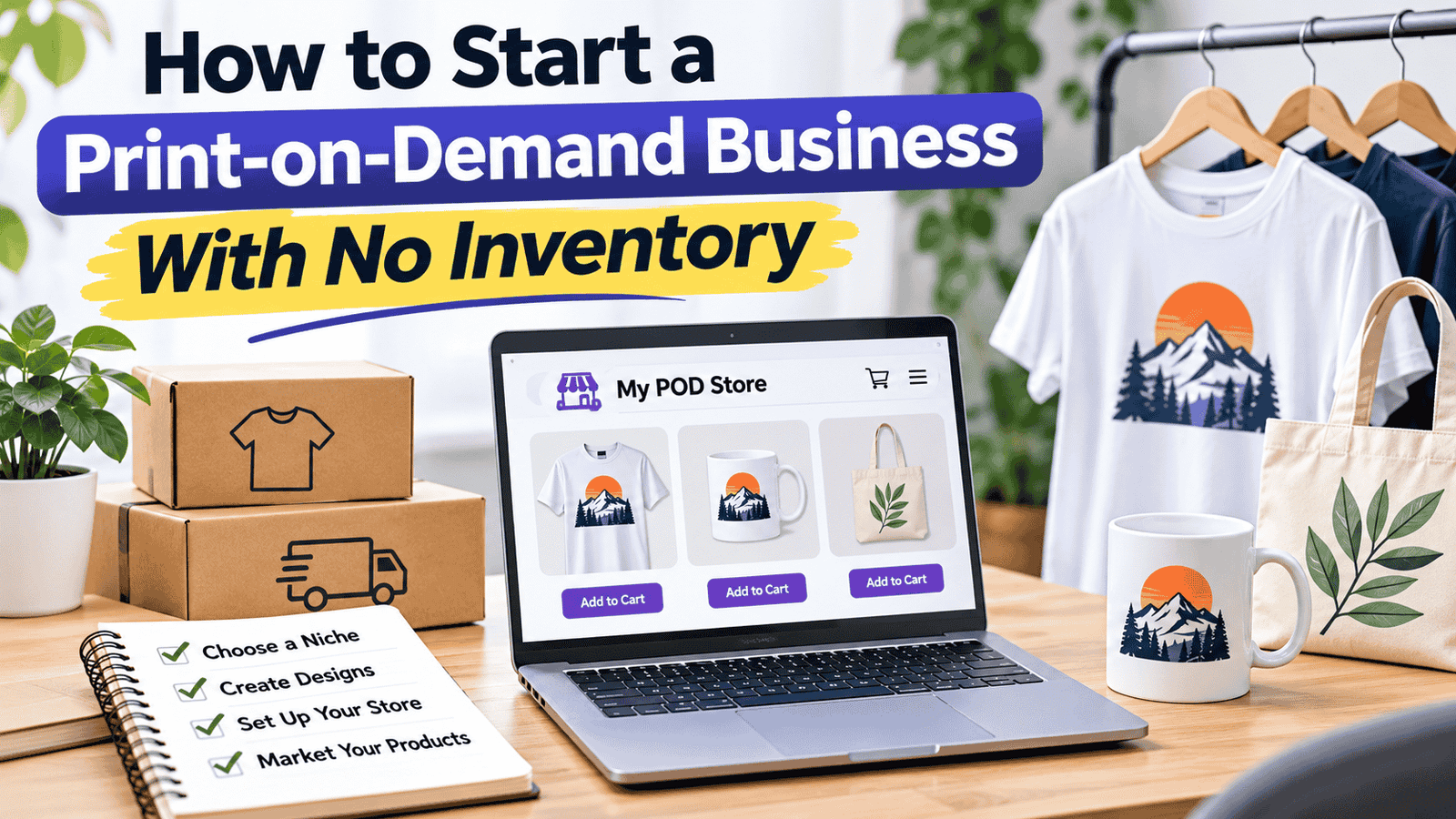
Starting an online business does not necessarily require a warehouse, expensive equipment, or thousands of dollars in stock. A print-on-demand business allows you to sell custom-designed products without purchasing inventory in advance. From T-shirts and hoodies to mugs, phone cases, posters, and tote bags, products are manufactured only after a customer places an order. The printing company handles production and shipping, while you focus on creating designs, building your store, and attracting customers.
This business model is particularly attractive to beginners who want to enter e-commerce with limited financial resources. However, success requires more than uploading a few designs and waiting for sales. You need to choose the right products, understand your target audience, calculate profit margins, and develop a marketing strategy. This guide explains how to build a print-on-demand business from scratch, even if you have no previous e-commerce experience.
What Is a Print-on-Demand Business?
Print-on-demand (POD) is an e-commerce business model in which products are printed, manufactured, or customized after a customer places an order.
Unlike traditional retail, you do not need to purchase products in bulk, store them at home, or manage a warehouse. Instead, you create digital designs and upload them to products offered by a print-on-demand supplier.
For example, imagine creating a T-shirt featuring an original motivational quote. You upload the design to your online store and list the shirt for $25. When someone purchases it, your supplier prints the design, prepares the package, and ships the product directly to the customer.
You earn the difference between your selling price and the total costs.
Popular products include:
- Custom T-shirts, sweatshirts, and hoodies.
- Coffee mugs and water bottles.
- Phone cases and laptop accessories.
- Posters, canvas prints, and wall art.
- Tote bags and backpacks.
- Notebooks, stickers, and stationery.
The biggest advantage is that you can test different products without committing money to large quantities of stock.
How Does Print-on-Demand Work?
The process is relatively straightforward. You manage the creative and commercial side, while your supplier handles the physical product.
Here is how a typical order moves through the system:
- Create a design: Develop an original design for a particular product.
- Upload your artwork: Add your design to products available through your POD provider.
- Publish your products: Connect the supplier to your online store or marketplace.
- Receive an order: A customer visits your store and purchases a product.
- Production begins: The supplier prints or applies your design to the selected product.
- Shipping and delivery: The supplier packages and ships the order to the customer.
- Receive your profit: Your store collects the customer's payment, and you pay the supplier's applicable production and fulfillment charges.
For example, if a customer orders a $30 hoodie, the supplier might charge $17 for production and fulfillment. Your remaining $13 is the initial difference before payment processing, advertising, platform fees, taxes, and other expenses.
You do not handle the hoodie yourself, but you remain responsible for customer service, product presentation, and resolving problems with orders.
Why Start a Print-on-Demand Business With No Inventory?
Traditional e-commerce often requires purchasing products before knowing whether customers will buy them. This creates financial pressure, particularly for beginners.
A print-on-demand business removes much of that initial inventory risk.
Here are some reasons entrepreneurs choose this model.
Lower upfront investment: You do not need to purchase hundreds of products before launching. You can start with digital designs and pay production costs when orders arrive.
No warehouse requirements: Products are manufactured and shipped by your supplier. You do not need dedicated storage space.
Easy product testing: You can experiment with different designs, colors, and product categories without holding unsold stock.
Location flexibility: Your store can operate online while production and fulfillment are handled by an external provider.
Room to expand: Once you understand what customers prefer, you can introduce additional products and collections.
However, no inventory does not mean no expenses. You may still need money for samples, website hosting, subscriptions, marketing, payment processing, and business administration.
Choose a Profitable Niche
One of the most important decisions is selecting the audience you want to serve.
A store that sells random designs for everyone can struggle to establish a recognizable identity. A focused niche makes it easier to create relevant products and reach people who are genuinely interested in them.
Consider these niche ideas:
|
Niche |
Potential Product Ideas |
|
Fitness and gym |
Workout T-shirts, water bottles |
|
Pet lovers |
Custom pet mugs, shirts |
|
Gaming |
Gaming-themed hoodies, posters |
|
Travel |
Travel-inspired tote bags, journals |
|
Education |
Teacher mugs, stationery |
|
Motivation |
Inspirational posters, apparel |
|
Hobbies |
Designs for readers, gardeners, and photographers |
How to Validate Your Niche
Do not select a niche simply because you personally like it. Look for evidence that people are interested in purchasing related products.
Use these approaches:
- Google Trends: Explore whether interest in your chosen topic is consistent or seasonal.
- Etsy: Examine popular product categories, customer reviews, and common design styles.
- Pinterest: Identify visual themes and product ideas that attract attention.
- Social media: Study communities, comments, and discussions to understand what potential customers enjoy.
- Marketplace research: Compare product prices, presentation, and customer expectations.
Look for a balance between customer interest and competition. A niche with an identifiable audience and opportunities for original designs is often a better starting point than an extremely broad category.
Find the Right Print-on-Demand Supplier
Your supplier directly affects product quality, delivery speed, customer satisfaction, and profit margins.
A beautiful design cannot compensate for poor printing or unreliable fulfillment. Before choosing a provider, compare its products, pricing, shipping arrangements, and integration options.
Some established print-on-demand platforms include:
1. Printful
offers a range of customizable products, including clothing, accessories, and home décor. It provides integrations with various e-commerce platforms and handles printing, packaging, and fulfillment.
2. Printify
Printify connects sellers with a network of print providers. This gives you different production options, although product quality, shipping costs, and delivery times can vary between providers.
3. Gelato
Gelato offers print-on-demand fulfillment through a distributed production network. It is worth considering if you want to serve customers in different international markets.
4. Redbubble
Redbubble operates as an artist marketplace where creators upload designs and make them available on different products. It can be useful for beginners who want to test demand without building a separate online store.
What Should You Compare?
Before committing to a supplier, examine:
- Base product and printing costs.
- Available product categories.
- Printing quality and customization options.
- Shipping destinations and estimated delivery times.
- Store integrations and order synchronization.
- Return, replacement, and damaged-product policies.
- Customer support and fulfillment reliability.
Order product samples whenever possible. Check the material, print placement, colors, packaging, and overall finish before promoting products to customers.
Create Designs People Want to Buy
Design is the foundation of your store. Customers are not simply purchasing a blank T-shirt or mug; they are buying something that reflects their personality, interests, humor, or lifestyle.
You do not need to be a professional graphic designer to begin. Basic design skills and a good understanding of your audience can help you create attractive products.
Start With Simple, Original Designs
Some practical design approaches include:
- Short motivational phrases.
- Minimalist illustrations.
- Niche-related typography.
- Simple geometric patterns.
- Personalized names and dates.
- Original artwork inspired by specific hobbies.
For example, a store targeting book lovers could offer mugs with reading-related illustrations, literary-inspired typography, and designs for people who enjoy collecting books.
Use the Right Design Tools
Several tools can help you prepare artwork:
- Canva: Useful for typography, layouts, and simple graphics.
- Adobe Illustrator: Suitable for professional vector illustrations.
- Adobe Photoshop: Helpful for detailed image editing.
- Photopea: A browser-based alternative for image editing.
Always check your supplier's requirements for image dimensions, file formats, resolution, and transparent backgrounds.
Understand Copyright and Trademarks
Never assume that an image, popular character, celebrity photograph, sports logo, or famous brand name is free to use.
Create original artwork or obtain appropriate commercial licenses. Also check the licensing terms of fonts, graphics, and other design assets.
Copying popular designs can lead to product removals, account restrictions, and legal disputes.
Build Your Online Store
Once you have selected your niche, supplier, and initial designs, the next step is creating a place where customers can browse and purchase your products.
There are several ways to launch your store.
Shopify
Shopify is a popular option for building an independent e-commerce store. You can customize its appearance, organize product collections, manage orders, and connect supported print-on-demand applications.
It offers more control over your brand, although subscription and other operating costs should be included in your budget.
Etsy
Etsy is a marketplace where customers search for handmade, personalized, and creative products. It can help sellers reach people who are already shopping for unique items.
Review its current seller policies, eligibility requirements, and applicable fees before launching.
WooCommerce
WooCommerce allows you to build an online store using WordPress. It provides flexibility over website design, content, and functionality, making it suitable for people who want more control over their website.
Hosting, extensions, maintenance, and payment arrangements may create additional costs.
What Your Store Should Include
A professional store should have:
- A memorable business name and logo.
- Clear product photographs and mockups.
- Detailed product descriptions.
- Accurate size and color information.
- Transparent shipping and return policies.
- Contact information and customer support.
- Secure and reliable payment options.
Keep the shopping experience simple. Customers should be able to understand what they are purchasing, how much it costs, and when they can reasonably expect delivery.
Set Prices and Calculate Your Profit
Pricing incorrectly is one of the easiest ways to make a store unprofitable.
Your selling price should cover production, fulfillment, payment processing, platform expenses, marketing, and other applicable costs.
Consider this hypothetical example:
|
Expense |
Amount |
|
Customer selling price |
$30 |
|
Product and printing |
$12 |
|
Shipping |
$5 |
|
Payment processing |
$1.50 |
|
Advertising cost per sale |
$4 |
|
Remaining profit |
$7.50 |
Illustrative calculation only. Actual costs depend on the supplier, destination, payment provider, and marketing channel.
The formula is:
Profit = Selling Price − Total Business Costs
Remember that revenue is not the same as profit. A store generating $1,000 in sales might earn considerably less after production, shipping, marketing, refunds, and other expenses.
Before setting prices, calculate your expected profit for each product. Also consider whether customers in your target market are willing to pay that amount.
Market Your Products and Get Your First Customers
Publishing products does not automatically generate sales. People need to discover your store, understand what makes your products appealing, and develop enough confidence to purchase.
Marketing should be part of your business plan from the beginning.
Use Pinterest for Product Discovery
Pinterest is useful for visually appealing products such as home décor, clothing, personalized gifts, and stationery.
Create attractive product pins, organize them into relevant boards, and use descriptive titles that match what potential customers search for.
Build an Audience on Instagram and TikTok
Short-form videos can help demonstrate products and communicate your brand identity.
Content ideas include:
- Showing different product designs.
- Presenting product mockups.
- Creating niche-related lifestyle content.
- Sharing design concepts and collections.
- Demonstrating how personalized products look.
- Featuring customer photographs with permission.
Focus on useful and interesting content rather than publishing sales messages repeatedly.
Optimize Your Product Listings for SEO
If you sell through Etsy or your own website, product descriptions and titles should clearly explain what customers are purchasing.
For example, instead of using a vague title such as "Cool Shirt," describe the product more specifically:
"Minimalist Fitness Motivation T-Shirt for Gym Lovers."
Include relevant product details, materials, sizes, colors, and care instructions. Use accurate search terms naturally rather than repeating unrelated keywords.
Experiment With Paid Advertising
Once you have tested your products and understand your audience, you can experiment with Facebook, Instagram, Pinterest, or other advertising platforms.
Start with a controlled budget. Compare different creatives and audiences, and monitor the actual cost of acquiring a customer.
Do not increase advertising spending simply because a campaign generates clicks. Measure purchases and profit instead.
Common Mistakes to Avoid
A print-on-demand business is relatively accessible, but avoidable mistakes can make it difficult to become profitable.
Choosing an overly broad niche: Selling everything to everyone makes branding and marketing harder. Begin with a clearly defined audience.
Ignoring product quality: Attractive mockups do not guarantee that the actual product will meet customer expectations. Order samples before launching major campaigns.
Underpricing products: Focusing only on competitor prices can leave you with insufficient profit after fulfillment and marketing expenses.
Uploading too many low-quality designs: A smaller collection of relevant, well-presented products is more useful than hundreds of random listings.
Ignoring shipping times: Customers should understand estimated delivery times before purchasing, particularly when products are manufactured internationally.
Using copyrighted artwork: Unauthorized designs can create serious business and legal problems. Develop original artwork and check licensing permissions.
Expecting immediate sales: A new store needs time to build visibility, test products, and understand customer behavior.
How Much Money Do You Need to Start?
One reason people consider print-on-demand is the possibility of starting without purchasing inventory.
However, a realistic startup budget should account for the costs of operating an online business.
Your initial expenses may include:
|
Expense |
Purpose |
|
Design software |
Creating product artwork |
|
Store subscription |
Hosting and operating your store |
|
Product samples |
Checking quality |
|
Domain name |
Establishing your brand |
|
Marketing |
Reaching potential customers |
|
Business expenses |
Payment fees and administration |
You can reduce initial expenses by using free design tools, starting with a small collection, and relying on organic social media marketing.
For example, a beginner could launch with five to ten carefully selected designs across a few products instead of immediately creating an extensive catalog.
Keep some money available for unexpected expenses, refunds, and order-related issues. Remember that suppliers may charge you for fulfillment before the payment processor releases the customer's funds.
The best approach is to start small, validate demand, and reinvest profits carefully rather than spending heavily before understanding your market.
Conclusion
A print-on-demand business offers a practical way to enter e-commerce without purchasing or storing inventory. You can create original designs, list products online, and let a fulfillment partner handle manufacturing and shipping after customers place orders.
The strongest starting point is not a large product catalog or an expensive website. It is a clear niche, attractive designs, a reliable supplier, realistic pricing, and a consistent marketing strategy.
Start with a small collection, order samples, test customer interest, and improve your products based on feedback. Treat the business as a long-term brand rather than expecting instant profits. With careful planning and continuous improvement, you can build an online store without managing physical inventory yourself.


Comments (0)
No comments yet. Be the first to share your thoughts!
Join the Conversation
Share your perspective, ask questions, and connect with other readers on this story.