
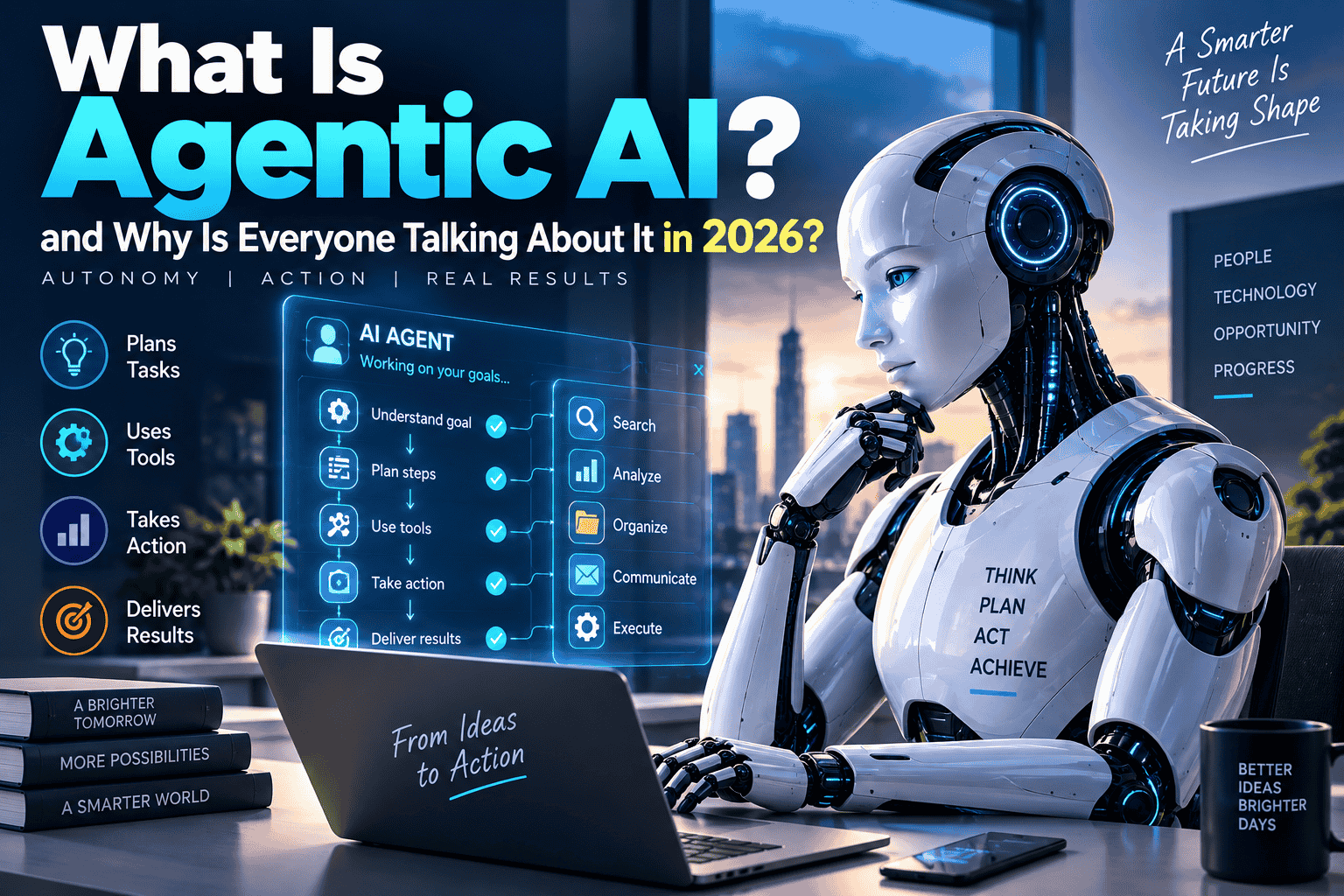
A new kind of software is moving beyond simply answering questions and generating content. Agentic AI refers to systems designed to pursue a goal, plan multiple steps, use digital tools, evaluate what happens, and continue working with a degree of autonomy. In 2026, interest in agentic AI has grown because businesses are increasingly exploring systems that can do more than assist employees—they can actually carry out parts of a workflow.
That distinction sounds small, but it changes how people think about software. Instead of opening five applications, copying information between them, and completing each step manually, a user may eventually describe the desired outcome and allow an agent to coordinate much of the process. The technology is promising, but it also introduces new questions about reliability, security, accountability, and human oversight.
What Is Agentic AI?
At its simplest, agentic AI is AI designed to act toward a goal, rather than merely produce a response to a single request.
A conventional chatbot might answer a question such as, "What meetings do I have tomorrow?" An agent could potentially take a broader instruction such as, "Review tomorrow's meetings, identify scheduling conflicts, suggest alternatives, and prepare the necessary changes for my approval."
The difference is the workflow.
An agentic system may:
1. Understand the objective.
2. Break the objective into smaller tasks.
3. Determine which tools or information it needs.
4. Perform actions through connected software.
5. Check the results.
6. Adjust its approach when something does not work.
7. Continue until the task is completed or human approval is required.
NIST describes AI agents as systems capable of planning and taking autonomous actions that can affect real-world systems or environments. Its 2026 work on agent security also highlights that combining model outputs with software functionality creates security issues that traditional software practices alone may not fully address.
The important word is autonomy. Agentic AI does not necessarily operate without people. Instead, it can be given a defined amount of freedom to decide how to accomplish a task.
How Does Agentic AI Work?
An agent is not simply a model with a chat window attached to it. The useful behavior comes from combining several components into a larger system.
Goal and planning
The system first interprets what the user wants to accomplish. A complex objective can then be divided into smaller actions.
For example, an employee might ask an agent to prepare a weekly sales report. The agent could identify the required data sources, retrieve relevant information, analyze changes, create a draft, and send it for review.
Tools and external systems
Agents become considerably more useful when they can interact with other software.
Depending on their permissions, an agent may be connected to databases, calendars, email, business applications, browsers, code repositories, or internal knowledge systems.
NIST notes that modern agent systems increasingly combine general-purpose models with software scaffolding that allows them to use tools and take actions beyond producing text.
Memory and context
A useful agent needs enough context to understand the current task. This might include information from a conversation, company documents, previous steps, or data retrieved from connected systems.
Good context management matters because an agent can make poor decisions if it is working with incomplete, outdated, or irrelevant information.
Evaluation and correction
An agent may also inspect the outcome of an action and decide what to do next. This is one reason agentic workflows can be more flexible than fixed automation.
However, flexibility also introduces uncertainty. The same task may not always be completed through exactly the same sequence of actions.
Agentic AI vs. Traditional AI Assistants
The easiest way to understand the difference is to compare their typical roles.
|
Traditional AI Assistant |
Agentic AI |
|
Primarily responds to requests |
Works toward defined goals |
|
Usually produces information or content |
Can plan and execute multiple steps |
|
Human performs most actions |
System can perform authorized actions |
|
Often follows a direct prompt-response pattern |
Can adapt during a workflow |
|
Limited interaction with external systems |
Designed to use tools and applications |
|
Human decides what happens next |
Agent may determine the next permitted step |
The distinction is not absolute. Some assistants already include automation and tool-use capabilities, while some so-called agents are essentially sophisticated workflows with limited autonomy.
That is why the term agentic AI can sometimes be used too broadly. Gartner has specifically warned that terminology around AI agents and agentic AI is becoming overused and confusing, making it important to evaluate what a system can actually do rather than relying on the label.
Why Is Agentic AI Getting So Much Attention in 2026?
The excitement around agentic AI is partly driven by a shift in expectations.
Generative AI demonstrated that software could produce useful text, images, code, and analysis from natural-language instructions. Agents extend that idea toward execution.
Instead of asking software to create a draft, businesses increasingly want systems that can move information through an entire process.
Microsoft's 2026 discussion of enterprise agents describes a direction in which groups of agents could execute longer-running work across functions such as software development, customer support, finance, human resources, and operations.
There is also growing commercial investment. Gartner reported in July 2026 that as much as $234 billion in enterprise application spending could be exposed to "agentic arbitrage" through 2030, referring to situations where agents perform tasks across multiple applications and reduce the need for people to interact separately with each software interface. This is a forecast, not a guaranteed outcome, but it illustrates why software companies are paying close attention to the technology.
Another reason is specialization. Gartner reported in September 2026 that its analysis of more than 100 agentic AI deployments pointed toward specialized, domain-specific agents as a major source of future business value.
The conversation is therefore moving from "Can an AI agent do something?" to "Where can an agent reliably do useful work?"
Where Agentic AI Is Being Used
The most practical applications tend to involve repetitive, multi-step processes where the required information and actions can be clearly defined.
Customer service
An agent could classify a support request, retrieve account information, check relevant policies, prepare a response, and escalate unusual cases to a human employee.
The goal is not necessarily to eliminate human support. A better-designed workflow can allow people to spend more time on complicated cases that require judgment.
Software development
Coding agents can potentially inspect a codebase, identify relevant files, propose changes, run tests, investigate failures, and prepare a change for human review.
This area is moving quickly because software development already consists of many digital steps that can be observed and verified.
Business operations
Agents can help coordinate tasks across finance, procurement, HR, sales, and internal administration.
For example, an operations agent might collect information from several systems, identify missing data, prepare a report, and route it to the appropriate person.
Research and analysis
Agents can search through large collections of documents, organize information, compare findings, and prepare structured research material.
Human review remains valuable, particularly when the information is sensitive, ambiguous, or consequential.
Personal productivity
Individuals may use agents to organize schedules, summarize information, manage routine digital tasks, or coordinate work across multiple applications.
The usefulness of these systems will depend heavily on what permissions they receive and how clearly the user can see and control their actions.
The Benefits of Agentic AI
The appeal of agentic systems comes from their ability to connect individual AI capabilities into complete workflows.
Less manual coordination
Many office processes involve moving information between applications. An agent can potentially reduce some of that repetitive coordination.
Faster completion of multi-step work
Instead of waiting for a person to perform every intermediate step, an agent can handle authorized tasks sequentially.
More accessible automation
Natural-language instructions could make certain forms of automation easier for people who do not know how to program traditional workflows.
Continuous operation
Software agents can potentially work outside normal office hours, which may be useful for monitoring, processing, and other routine activities.
Better use of specialized systems
Rather than replacing existing business software, agents can act as a layer that coordinates information and actions across multiple systems.
This last point may prove particularly important. The value of an agent is often not the model itself but its ability to connect the model to useful data, tools, permissions, and business processes.
The Risks and Limitations
The autonomy that makes agentic AI attractive also creates new risks.
Incorrect actions
A normal incorrect answer can often be ignored. An incorrect action can have consequences.
If an agent sends an email, changes a record, modifies software, or purchases something without appropriate controls, the problem is no longer limited to inaccurate text.
Security threats
Agents can be exposed to malicious instructions hidden inside websites, documents, emails, or other information they process.
NIST has specifically studied "agent hijacking," where malicious instructions can influence an agent through data it encounters and cause unintended actions.
Excessive permissions
Giving an agent access to every system it might possibly need can create unnecessary risk. Permissions should be limited to what the workflow actually requires.
Difficult evaluation
Traditional software can often be tested against predictable inputs and outputs. Agentic workflows may involve multiple steps and changing conditions.
Gartner has noted that output-focused evaluation alone is not sufficient for the nondeterministic behavior of agentic workflows, highlighting the need to evaluate how agents behave throughout a task.
Accountability
When an autonomous system makes a mistake, organizations need to know who is responsible for the system, what it was allowed to do, what information it used, and why the action occurred.
That is why governance is becoming a major part of the agent conversation rather than an optional feature added later.
How Businesses Should Approach AI Agents
Organizations do not need to give agents control over everything to benefit from them.
A sensible starting point is a narrow, measurable workflow.
Start with a specific problem
Instead of asking, "Where can we use agents?" identify a process that consumes significant time and has clearly defined inputs and outputs.
Keep humans involved where judgment matters
Approvals can be required for actions involving sensitive information, money, legal commitments, external communications, or major operational changes.
Limit permissions
An agent should have access only to the systems and actions required for its assigned task.
Measure the complete workflow
Useful measurements might include completion time, error rates, escalation rates, human review effort, and the frequency of successful task completion.
Build monitoring from the beginning
Organizations need visibility into what agents are doing, not just whether they eventually produce a result. Enterprise platforms are increasingly adding centralized controls, monitoring, governance, and agent management for this reason.
The strongest implementations are likely to treat agents as operational systems that require testing, monitoring, security controls, and continuous improvement.
What Could Happen Next?
The next phase of agentic AI is likely to involve greater specialization and coordination.
Instead of one universal agent attempting to handle every task, organizations may use different agents for software development, customer support, finance, research, security, or internal operations.
Those agents could potentially coordinate with one another while operating under shared policies and permissions.
This direction is already visible in enterprise technology. Microsoft, IBM, and other major technology companies are developing platforms specifically for building, deploying, coordinating, and governing agents rather than treating them simply as chatbot features.
Standards are also becoming part of the conversation. In February 2026, NIST announced an AI Agent Standards Initiative focused on secure adoption and interoperability across the developing agent ecosystem.
The important question is therefore not whether every piece of software will become autonomous. It is where autonomy creates enough value to justify the additional complexity and risk.
Conclusion
Agentic AI represents a shift from software that mainly responds to people toward software that can pursue goals through multi-step actions.
That shift explains much of the excitement surrounding the technology in 2026. Agents can potentially coordinate applications, automate workflows, support employees, conduct research, and handle routine tasks with less manual intervention.
At the same time, autonomy creates responsibilities that traditional software does not always face in the same way. Security, permissions, monitoring, reliability, evaluation, and human oversight become central considerations.
The most useful way to think about agentic AI is not as a magical replacement for human work, but as a new type of software system. Its real value will come from giving the right systems the right amount of autonomy, within clearly defined boundaries, to solve problems that actually matter.
Comments (0)
No comments yet. Be the first to share your thoughts!
Join the Conversation
Share your perspective, ask questions, and connect with other readers on this story.