
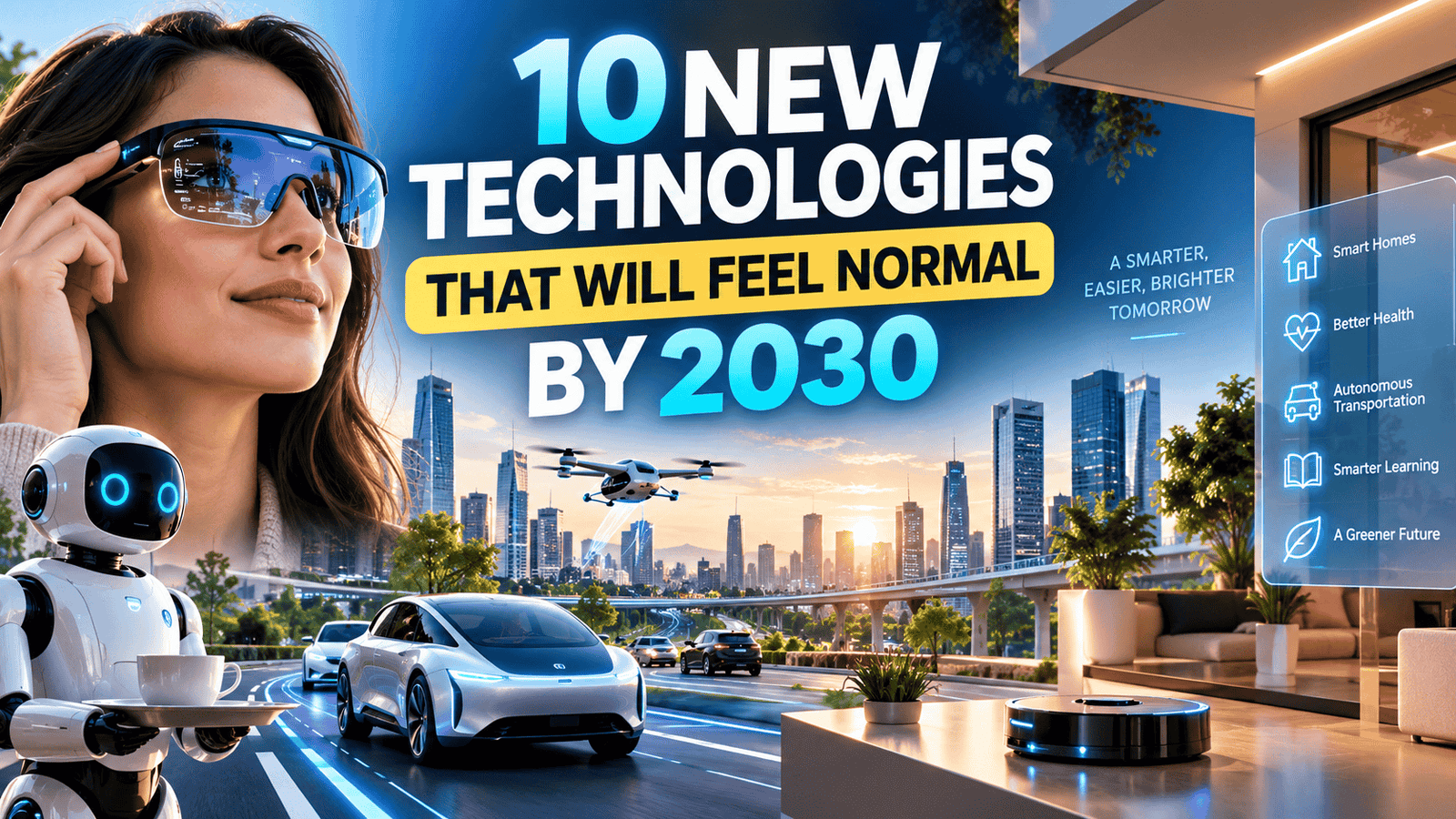
The biggest technological changes of the next few years may not arrive as dramatic inventions. Instead, many of them will quietly become part of everyday life until using them feels as ordinary as opening a smartphone or connecting to Wi-Fi.
By 2030, technologies that currently seem expensive, experimental, or limited to certain industries could become familiar to ordinary households and workplaces. AI-powered devices, autonomous systems, spatial computing, advanced robotics, smart health technology, and new energy solutions are already moving in that direction.
This article explores 10 new technologies that could feel normal by 2030, how they may affect everyday life, where they are most likely to appear, and what limitations could slow their adoption.
AI-Powered Personal Devices
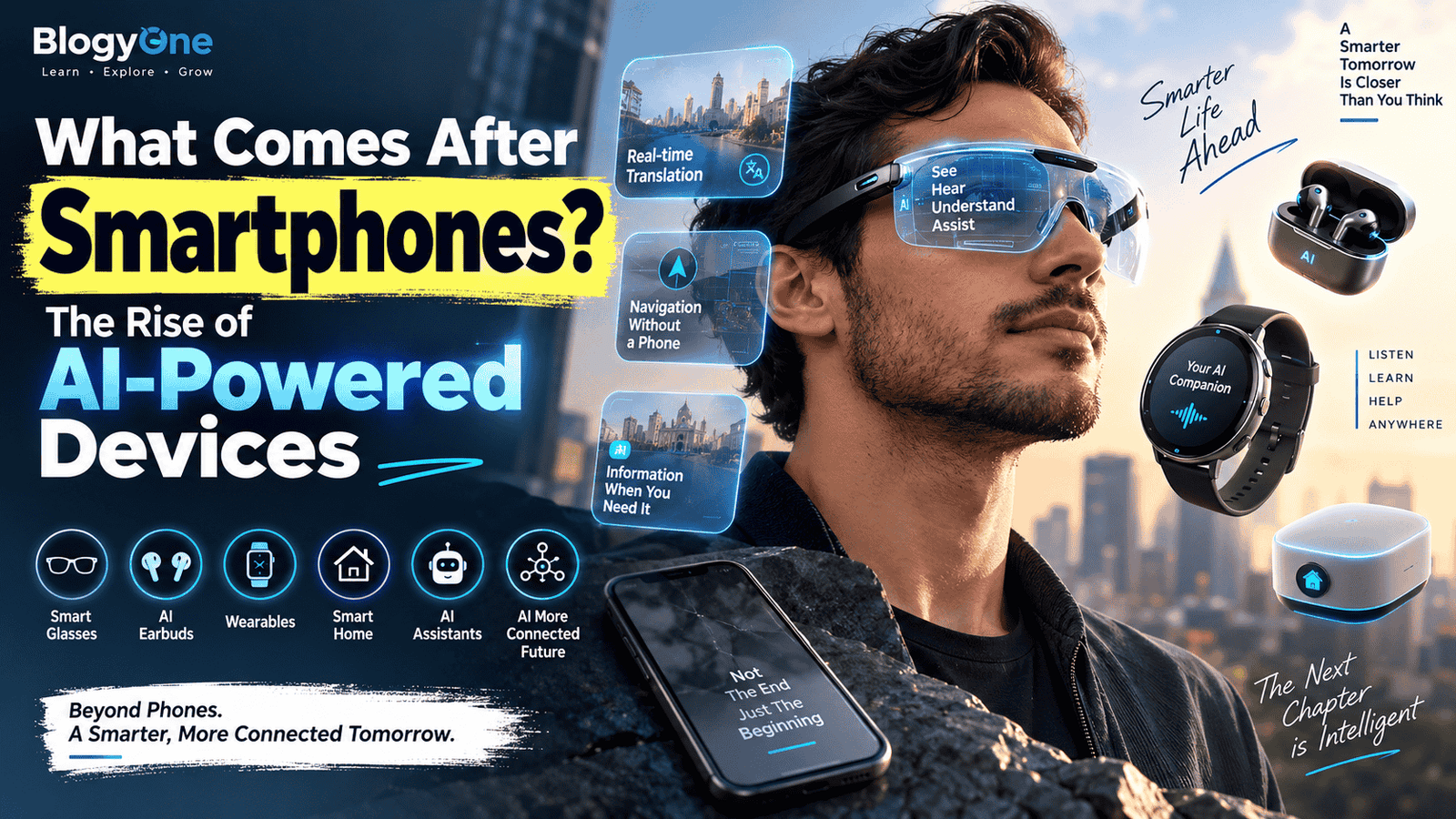
The smartphone may not disappear by 2030, but the way people use personal technology is likely to change significantly.
Today's devices largely wait for instructions. You open an app, search for something, type a message, or manually perform a task. AI-powered devices are moving toward a more proactive model in which the device understands context and helps complete tasks.
From apps to assistance
Imagine telling your device, "I need to leave for the airport at 6 PM," and having it consider traffic, check your calendar, suggest when to leave, and prepare relevant travel information.
The important change is not simply having AI inside a device. It is the combination of AI with sensors, personal data, connectivity, and software that can perform useful actions.
Phones, computers, earbuds, watches, and other connected devices could increasingly function as personal assistants rather than simple tools.
The challenge of trust
The more useful these systems become, the more information they may need. That creates questions around privacy, security, accuracy, and user control.
For AI-powered personal devices to become truly normal, people will need to feel comfortable with what their devices can see, hear, remember, and do.
AI Wearables and Smart Glasses
Smart glasses have existed for years, but previous generations struggled to become mainstream. Smaller hardware, better batteries, improved cameras, and increasingly capable AI could change that.
By 2030, lightweight glasses may be able to provide information without requiring users to constantly look down at a phone.
What smart glasses could do
Potential everyday uses include:
· Translating signs and conversations
· Providing directions while walking
· Identifying objects or places
· Displaying notifications
· Capturing photos and video
· Offering hands-free assistance
· Providing accessibility features
Instead of pulling out a phone to check information, a person could potentially receive it through a wearable interface.
The biggest obstacles will likely include battery life, comfort, privacy concerns, social acceptance, and the usefulness of the information displayed.
Household Robots
Robots are often associated with factories, warehouses, and science-fiction movies. That distinction could become less important during the next decade.
Robotic vacuum cleaners have already demonstrated that consumers will accept machines performing physical tasks inside their homes. More capable robots could eventually handle a wider range of repetitive household activities.
Beyond vacuuming
Future household robots could assist with tasks such as moving objects, organizing items, monitoring certain areas of a home, helping elderly people with routine activities, or performing basic chores.
The difficult part is that homes are unpredictable. A factory provides robots with controlled environments, while a home contains stairs, pets, children, furniture, fragile objects, and constantly changing layouts.
That means useful household robots will need much better perception, movement, safety systems, and reliability than simple automated appliances.
Autonomous Transportation
Self-driving technology may become increasingly visible by 2030, although adoption will probably vary considerably between countries and cities.
Autonomous vehicles do not necessarily need to replace every human-driven car to have a major impact. They could become particularly useful in controlled or repetitive transportation environments.
Where autonomy may arrive first
Autonomous systems could become common in:
· Robotaxi services
· Delivery vehicles
· Warehouses
· Industrial sites
· Airports
· Public transportation
· Long-distance freight routes
A major advantage is that autonomous transportation can potentially operate for long periods without human fatigue. However, safety, regulation, infrastructure, weather conditions, liability, and public confidence remain significant challenges.
The most realistic future may therefore be a mixed transportation environment where autonomous and human-driven vehicles operate together.
Spatial Computing and Mixed Reality
Computing is gradually moving beyond flat screens.
Spatial computing combines digital information with the physical environment, allowing virtual objects to appear anchored within real spaces. Mixed-reality headsets are an early example of this direction.
Everyday applications
A technician could see instructions positioned next to a machine. A student could explore a three-dimensional model of the human body. An architect could walk around a virtual building before construction begins.
At home, spatial technology could also create virtual screens, entertainment environments, or interactive educational experiences.
The technology still faces practical barriers, particularly device size, price, battery life, comfort, and the amount of time people actually want to wear a headset.
By 2030, however, spatial interfaces could become much more specialized and useful rather than simply being treated as futuristic entertainment.
Personalized Health Technology
Healthcare technology is moving toward continuous monitoring and more personalized information.
Smartwatches and other wearable devices already measure things such as heart rate, activity, sleep patterns, and other physiological signals. Future devices may collect a broader range of health-related information.
From occasional measurements to continuous information
Instead of receiving health information only during occasional appointments, people may increasingly have access to long-term personal trends.
This could help users notice changes worth discussing with healthcare professionals. Doctors may also benefit from having more information about a patient's everyday patterns rather than relying entirely on measurements taken during a short clinical visit.
However, health technology should not be confused with professional diagnosis. Accuracy, false alarms, privacy, data ownership, and clinical validation will remain important considerations.
Smart Homes That Actually Understand You
The smart home has existed for years, but many systems still require users to manually create routines.
By 2030, smart homes could become considerably more context-aware.
A more responsive home
Instead of programming every individual action, a home might learn recurring patterns and coordinate different systems.
For example, when someone arrives home, lighting, temperature, security, and entertainment systems could respond based on the circumstances. Energy-consuming appliances could also be coordinated with electricity availability and household preferences.
The goal is not simply to put more gadgets into a house. The real transformation comes from connecting those devices so that they work as one system.
That also creates a major security issue: a highly connected home provides more potential entry points for attackers. Strong authentication, software updates, and secure device design will therefore become increasingly important.
Advanced Battery and Energy Technology
Many future technologies depend on one deceptively important component: energy storage.
Electric vehicles, renewable energy systems, portable electronics, robots, and data centers all benefit from improvements in batteries and energy management.
By 2030, consumers may encounter batteries with better energy density, faster charging characteristics, longer useful lifetimes, or improved safety compared with today's common technologies.
Why batteries matter so much
Better energy storage can make renewable electricity more practical by helping store energy when production is high and use it when demand increases.
It can also reduce some of the limitations of electric vehicles and mobile devices.
Not every promising battery technology will become commercially dominant, though. Manufacturing costs, raw materials, durability, charging infrastructure, recycling, and large-scale production will determine which technologies actually reach consumers.
AI-Powered Learning and Workplaces
Education and office work could become much more personalized by 2030.
Instead of every learner receiving exactly the same explanation, digital learning systems could adapt lessons to an individual's pace, mistakes, and preferred method of learning.
A more personalized learning experience
A student struggling with a mathematical concept could receive another explanation, additional practice, or a visual example rather than simply moving to the next chapter.
Workplaces could experience a similar transformation. Software may help employees summarize information, search internal knowledge, prepare documents, analyze data, or automate repetitive administrative tasks.
The most valuable systems will not simply produce information. They will help people make better use of their time while leaving important judgment and accountability with humans.
This could also change the skills employers value. Knowing how to work with intelligent software may become as ordinary as knowing how to use spreadsheets or presentation software today.
Digital Twins and Intelligent Infrastructure
A digital twin is a virtual representation of a physical object, system, or environment that can be updated using information from the real world.
The concept is already used in areas such as manufacturing and engineering, but it could become more widespread as sensors and computing become cheaper.
Cities and buildings as digital systems
A building could have a digital model that helps managers understand energy consumption, equipment performance, and maintenance needs.
Factories could use virtual models to test changes before modifying physical machinery. Cities could potentially model traffic patterns, infrastructure projects, and energy systems.
This technology could make maintenance more predictive. Instead of waiting for equipment to fail, operators may identify unusual behavior and investigate it earlier.
The challenge is data quality. A digital model is only as useful as the information feeding it.
What Will Stop These Technologies From Becoming Normal?
Technology adoption is rarely determined by technical capability alone.
A product can work extremely well and still fail to become mainstream if it is too expensive, inconvenient, unreliable, difficult to use, or socially uncomfortable.
Several factors will influence which technologies become genuinely normal by 2030.
Cost
Mass adoption usually requires technology to become affordable enough for ordinary consumers and businesses.
Privacy
Devices that constantly collect information will need strong privacy protections and transparent controls.
Regulation
Autonomous vehicles, health technology, biometric systems, and other emerging technologies may face different regulations across countries and regions.
Reliability
People tolerate occasional problems with experimental technology. They expect dependable performance from something they use every day.
Social acceptance
Some technologies may be technically possible but unpopular because people dislike the way they affect privacy, relationships, employment, or everyday behavior.
The technologies that succeed will probably be those that solve real problems without creating more friction than they remove.
Conclusion
By 2030, the most noticeable technological transformation may not be one revolutionary invention. It may be the gradual disappearance of boundaries between digital services, physical devices, and intelligent automation.
AI-powered personal devices could reduce the need to interact manually with software. Smart glasses could make digital information more accessible in the physical world. Robots could handle more routine physical work, while autonomous transportation could reshape selected forms of mobility. At the same time, better health monitoring, smarter homes, improved energy storage, personalized learning, and digital twins could quietly become part of everyday infrastructure.
Not every prediction will happen exactly as expected. Some technologies will arrive later, while others may develop in ways that are difficult to anticipate today.
The useful question is therefore not simply which futuristic gadgets will exist by 2030. It is which technologies can become affordable, reliable, secure, and genuinely useful enough that people eventually stop thinking of them as futuristic at all.
Comments (0)
No comments yet. Be the first to share your thoughts!
Join the Conversation
Share your perspective, ask questions, and connect with other readers on this story.