
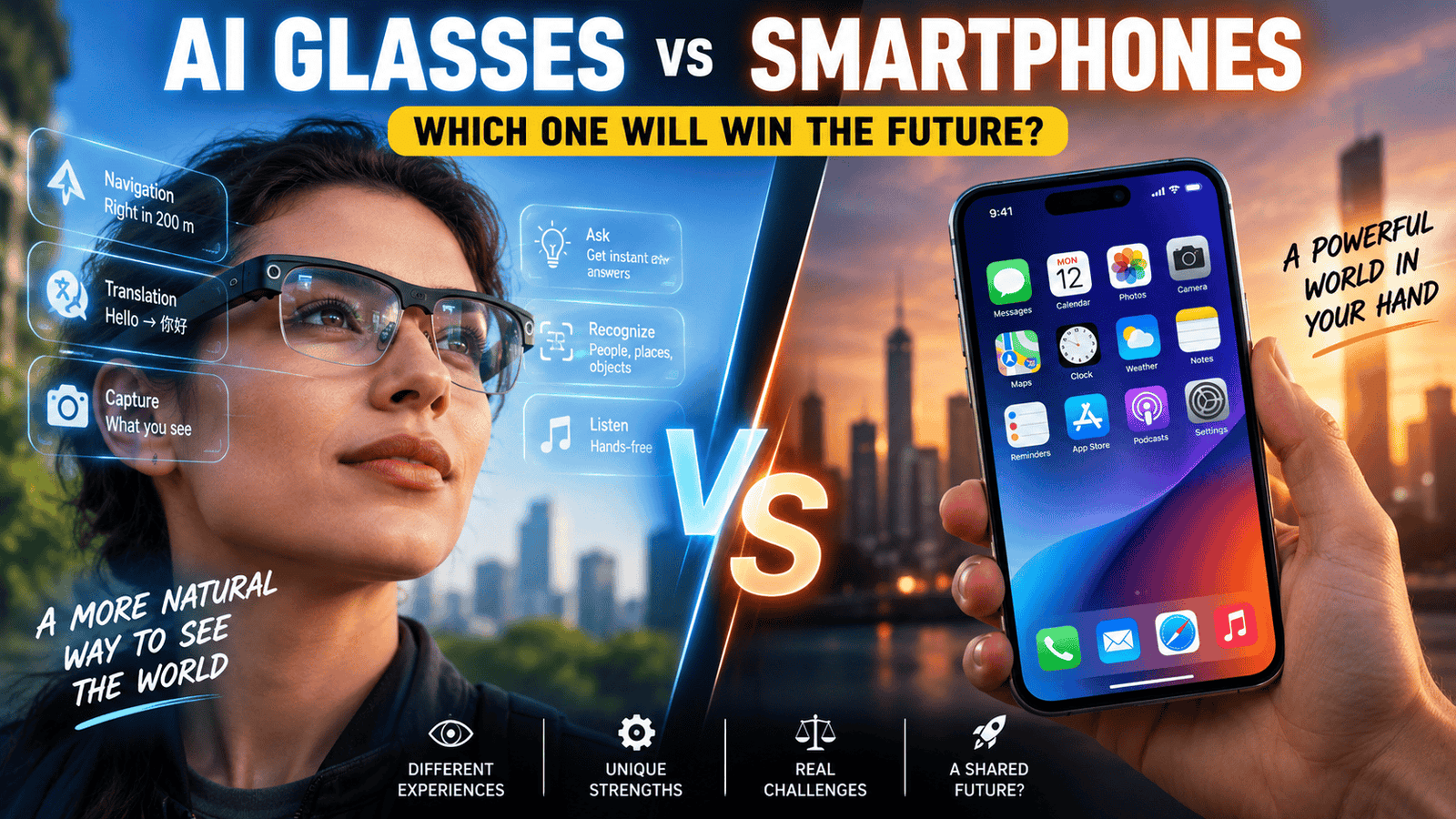
For years, the smartphone has been the device people use to communicate, search, navigate, capture memories, work, and entertain themselves. But a new category of technology is moving those tasks closer to the way humans naturally interact with the world: AI glasses.
Instead of pulling a phone from your pocket, you could look at an object, ask a question, hear directions, capture a photo, or receive information without breaking eye contact with your surroundings.
That raises an interesting question: AI glasses vs smartphones — which device will dominate the future?
The answer may not be as simple as one replacing the other. Smartphones are powerful, versatile, and deeply established, while AI glasses offer a more natural and hands-free way to access digital information. Understanding where each device excels helps reveal what personal technology could look like over the next decade.
What Are AI Glasses?
AI glasses are wearable devices designed to combine the functions of ordinary eyewear with computing, cameras, microphones, speakers, connectivity, and intelligent software.
Not every smart-glasses product works in exactly the same way. Some primarily provide audio and camera capabilities, while others can display digital information directly in the user's field of view.
What can AI glasses do?
Depending on the hardware and software, AI glasses can potentially perform tasks such as:
- Taking photos and recording videos.
- Answering spoken questions.
- Playing music and podcasts.
- Making calls.
- Providing navigation or contextual information.
- Translating or interpreting information.
- Recognizing objects or visual details.
- Offering hands-free assistance.
- Connecting to a smartphone for additional processing and internet access.
The key difference is how the technology is accessed.
A smartphone requires you to look down at a screen and physically interact with it. Glasses can make digital assistance available while your attention remains directed toward the environment.
AI glasses are not necessarily standalone computers
A common misconception is that AI glasses must completely replace smartphones.
In practice, many wearable devices can depend on a smartphone, cloud services, or both for connectivity and processing. This creates a relationship similar to accessories that extend the capabilities of a primary device.
That distinction matters when comparing AI glasses vs smartphones. The future may involve both rather than an immediate replacement.
AI Glasses vs Smartphones: How They Differ
The biggest difference isn't simply hardware. It is the interaction model.
A smartphone places a digital interface in front of you. AI glasses attempt to make computing more ambient and contextual.
|
Feature |
AI Glasses |
Smartphones |
|
Hands-free use |
Strong advantage |
Limited |
|
Screen-based interaction |
Limited or model-dependent |
Excellent |
|
Photography |
Convenient and immediate |
Highly capable |
|
Calling |
Hands-free |
Excellent |
|
Web browsing |
Less convenient |
Excellent |
|
Navigation |
Potentially more natural |
Highly established |
|
Gaming |
Limited compared with phones |
Extensive |
|
Battery capacity |
Constrained by size |
Generally larger |
|
Privacy concerns |
Significant |
Established but different |
|
Portability |
Extremely convenient |
Very portable |
|
Productivity |
Useful for quick tasks |
Better for complex tasks |
|
App ecosystem |
Developing |
Mature |
This comparison highlights an important point: AI glasses and smartphones are optimized for different types of interaction.
A person might prefer glasses for a quick question while walking and a smartphone for writing a long email.
Where AI Glasses Have the Advantage
AI glasses become particularly interesting when convenience and environmental awareness matter.
Hands-free interaction
Imagine walking through an unfamiliar city. Instead of stopping to look at your phone, you could potentially receive navigation guidance through your glasses.
Similarly, while cooking, repairing something, shopping, or working with equipment, hands-free access can be much more practical than repeatedly touching a phone.
The value isn't necessarily that glasses perform more computing. Their advantage is that they can reduce the physical effort required to access computing.
More natural access to information
A smartphone asks users to switch their attention from the physical world to a screen.
Glasses can potentially work in the opposite direction.
You remain focused on what you're doing while receiving relevant digital assistance. This could be useful for translation, object identification, reminders, navigation, and other context-dependent tasks.
Faster capture of moments
A phone must usually be taken out, unlocked, positioned, and operated before capturing a moment.
Glasses equipped with cameras can make photography and video recording more immediate.
That could be useful when the important moment lasts only a few seconds.
Potential for accessibility
Hands-free interfaces could also offer meaningful benefits for people who find conventional touchscreen interaction difficult.
Voice commands, audio feedback, visual assistance, and contextual information may create alternative ways to interact with digital services.
The actual benefit, however, depends heavily on the design and accessibility features of a particular product.
Why Smartphones Are Still Difficult to Replace
The excitement around AI glasses shouldn't obscure the strengths of smartphones.
Phones have spent more than a decade becoming highly capable general-purpose computers that fit into a pocket.
Smartphones have large, practical displays
Reading a long document, editing a spreadsheet, watching a detailed video, managing a website, editing photographs, or writing a substantial message is easier on a phone-sized screen than through a tiny wearable interface.
Even advanced glasses cannot remove the usefulness of having a larger display when the task demands visual detail.
The smartphone ecosystem is enormous
Modern phones provide access to banking, maps, cameras, messaging, social networks, productivity tools, games, shopping, education, and countless other services.
Developers already understand smartphone platforms, and users already know how to interact with them.
For AI glasses to replace phones, they would need more than impressive hardware. They would need an ecosystem capable of supporting the enormous variety of tasks people currently perform on smartphones.
Battery and physical constraints
Glasses have an obvious engineering limitation: they must remain lightweight and comfortable enough to wear.
A smartphone can accommodate a relatively large battery and substantial computing hardware. Glasses have much less physical space.
That creates difficult trade-offs involving battery life, weight, heat, cameras, speakers, processors, connectivity, and appearance.
Phones are better for complex tasks
Voice commands are excellent for many short interactions, but some tasks require careful visual control.
For example, creating a presentation, comparing multiple documents, editing a video, programming, filling out a complicated form, or managing detailed settings is likely to remain easier on a conventional screen.
The Biggest Challenges Facing AI Glasses
The technology has potential, but several barriers could determine how quickly it becomes mainstream.
Privacy and social acceptance
A camera mounted on someone's face creates a different social dynamic from a smartphone camera.
People may become uncomfortable if they don't know whether someone wearing smart glasses is recording them.
Manufacturers therefore face a difficult balance between useful features and clear signals that communicate when cameras or microphones are active.
Social acceptance could become just as important as technical performance.
Comfort and design
People already choose glasses based on appearance, weight, fit, lenses, and comfort.
Adding electronics makes those requirements harder to satisfy.
A successful pair of AI glasses needs to feel like something people naturally want to wear rather than a miniature computer strapped to their face.
Battery life
Small batteries limit how long wearable electronics can operate.
Frequent charging could quickly become frustrating if users expect glasses to remain available throughout the day.
Improving energy efficiency will therefore be crucial.
Dependence on connectivity
Many intelligent functions can require internet connectivity or a connected phone.
If a feature depends heavily on remote services, weak connectivity can reduce its usefulness.
For glasses to become a primary computing platform, more capabilities may need to work reliably with limited connectivity.
Information overload
Putting digital assistance closer to your senses doesn't automatically make technology better.
Constant notifications, prompts, audio responses, or visual overlays could become distracting.
The best wearable technology may ultimately be the technology that knows when not to interrupt.
How AI Glasses and Smartphones Could Work Together
The most realistic future may not be an AI glasses vs smartphones battle at all.
Instead, the two devices could form a personal computing system.
Glasses for quick interactions
AI glasses could handle lightweight tasks such as:
- Asking short questions.
- Capturing photos.
- Listening to messages.
- Receiving navigation guidance.
- Translating signs or speech.
- Identifying information in the environment.
- Controlling music or calls.
These interactions don't necessarily require a large screen.
Smartphones for deeper work
The phone could remain the place for tasks requiring greater control:
- Writing long documents.
- Editing media.
- Managing finances.
- Complex communication.
- Detailed browsing.
- Gaming.
- Professional applications.
- Advanced settings and account management.
This division makes practical sense. The glasses become the interface for immediate information, while the smartphone remains the general-purpose computing hub.
A shift from screen-first to context-first computing
This could represent a broader change in personal technology.
Instead of asking people to open an application and then perform an action, future devices may increasingly understand the situation first.
For example, rather than opening a translation app, selecting a language, activating the camera, and pointing it at a sign, a wearable could potentially recognize that the user needs translation and provide assistance more directly.
The technology still needs to get this interaction right. But the underlying concept is significant: computing becomes less about navigating menus and more about interacting naturally.
What the Future of Personal Technology May Look Like
The future will probably not be determined by which device has the longest feature list. It will be determined by which device fits naturally into people's lives.
AI glasses could become the everyday interface
If glasses become comfortable, affordable, socially accepted, privacy-conscious, and sufficiently capable, they could become an important everyday interface for digital information.
They would be particularly useful for tasks that benefit from immediate access without requiring a screen.
Smartphones may become less visible, not irrelevant
Even if people eventually use their phones less frequently, smartphones could remain important behind the scenes.
They can provide connectivity, storage, authentication, processing, application access, and a larger interface when necessary.
This would be similar to how computers remain important even as people increasingly access services through smaller devices.
Specialized devices may share the workload
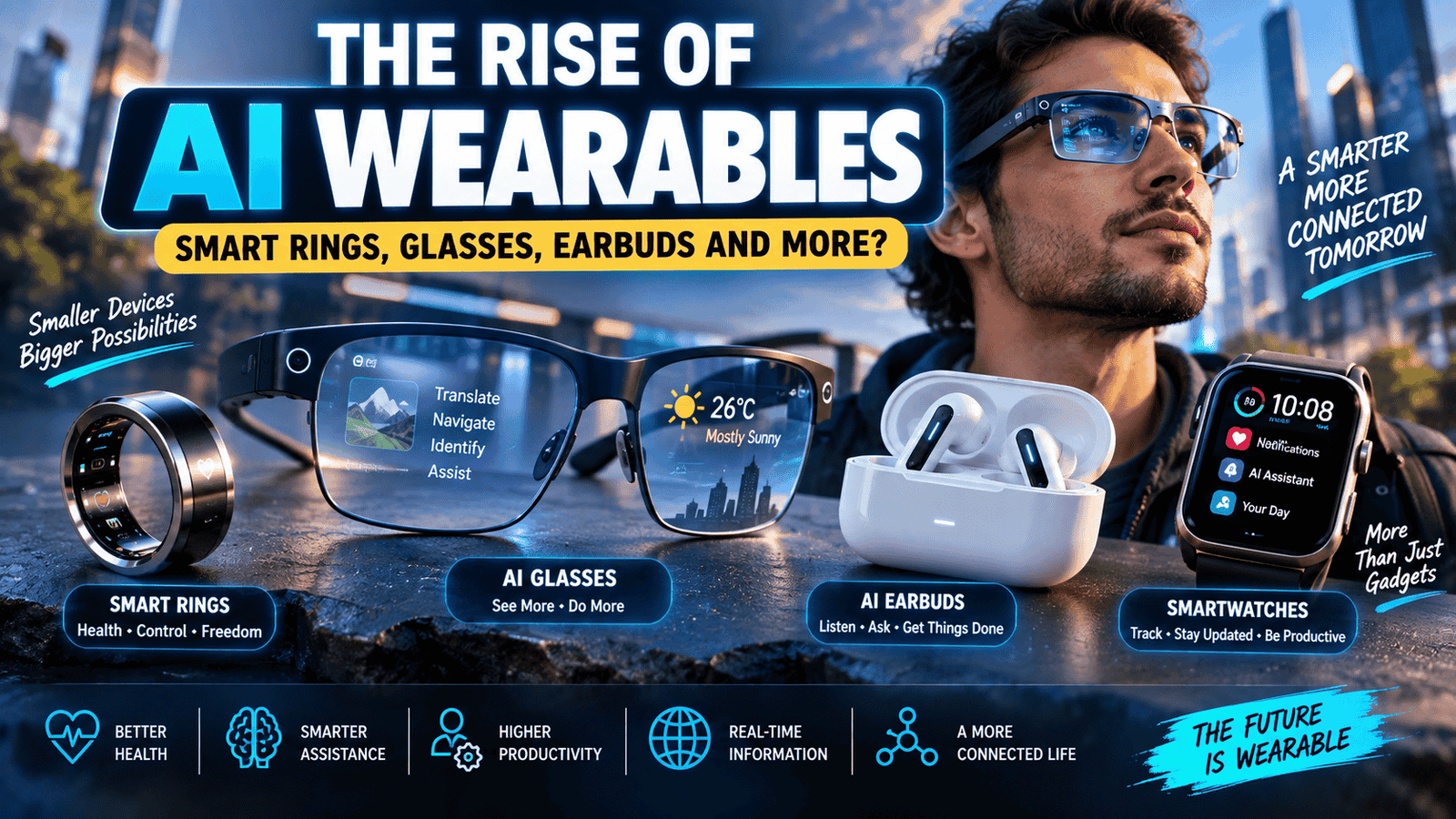
Future personal technology could consist of several interconnected devices:
- Glasses for visual and contextual interaction.
- Earbuds for private audio.
- Smartphones for general computing.
- Watches for quick controls and health or activity functions.
- Cloud services for storage and computational tasks.
Rather than one device doing everything, each device could handle the interactions for which its physical form is best suited.
The real winner may be the interface
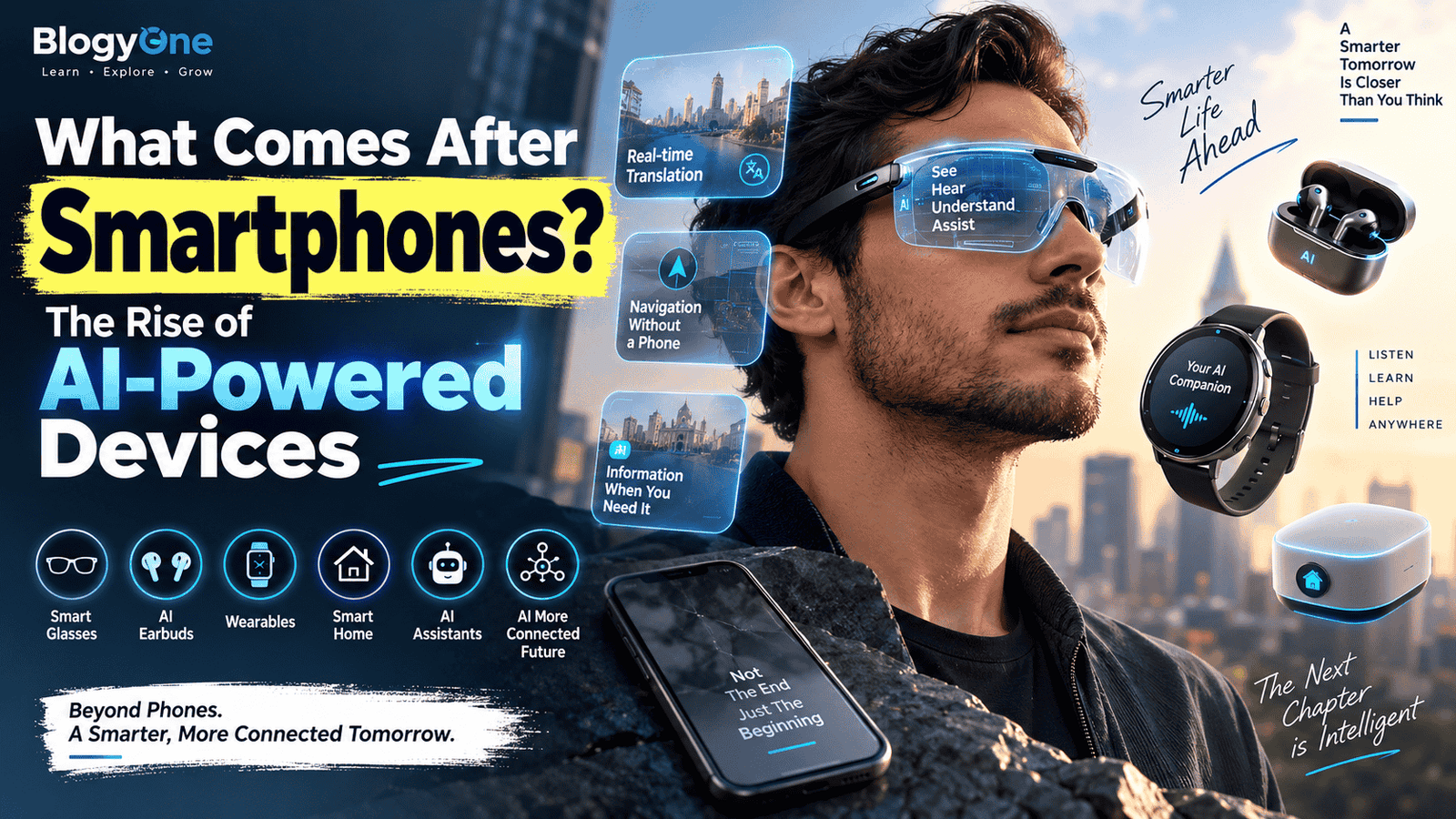
The most important development may not be the disappearance of the smartphone.
It may be the gradual disappearance of the need to think about which application to open.
If wearable technology can make digital services accessible through natural speech, vision, gestures, and context, the way people interact with computers could change substantially.
That would make AI glasses less of a "replacement phone" and more of a new layer between people and their digital environment.
Conclusion
The AI glasses vs smartphones debate is often framed as a competition in which one device must eventually eliminate the other. The more practical possibility is coexistence.
Smartphones remain extremely strong at complex tasks, detailed visual interaction, productivity, entertainment, and access to mature application ecosystems. AI glasses have a different advantage: they can bring digital assistance closer to the user's natural field of attention while keeping their hands free.
For AI glasses to genuinely replace smartphones, they would need to overcome major challenges involving battery life, comfort, privacy, connectivity, social acceptance, and complex computing. That is a much higher bar than simply making glasses capable of answering questions or taking pictures.
The likely direction is therefore a gradual shift toward multiple connected devices, with glasses handling immediate, contextual interactions and smartphones continuing to provide deeper computing when a larger interface is needed.
The future of personal technology may not belong to one device. It may belong to a more seamless relationship between the devices people already carry and the ones they wear.
Comments (0)
No comments yet. Be the first to share your thoughts!
Join the Conversation
Share your perspective, ask questions, and connect with other readers on this story.