
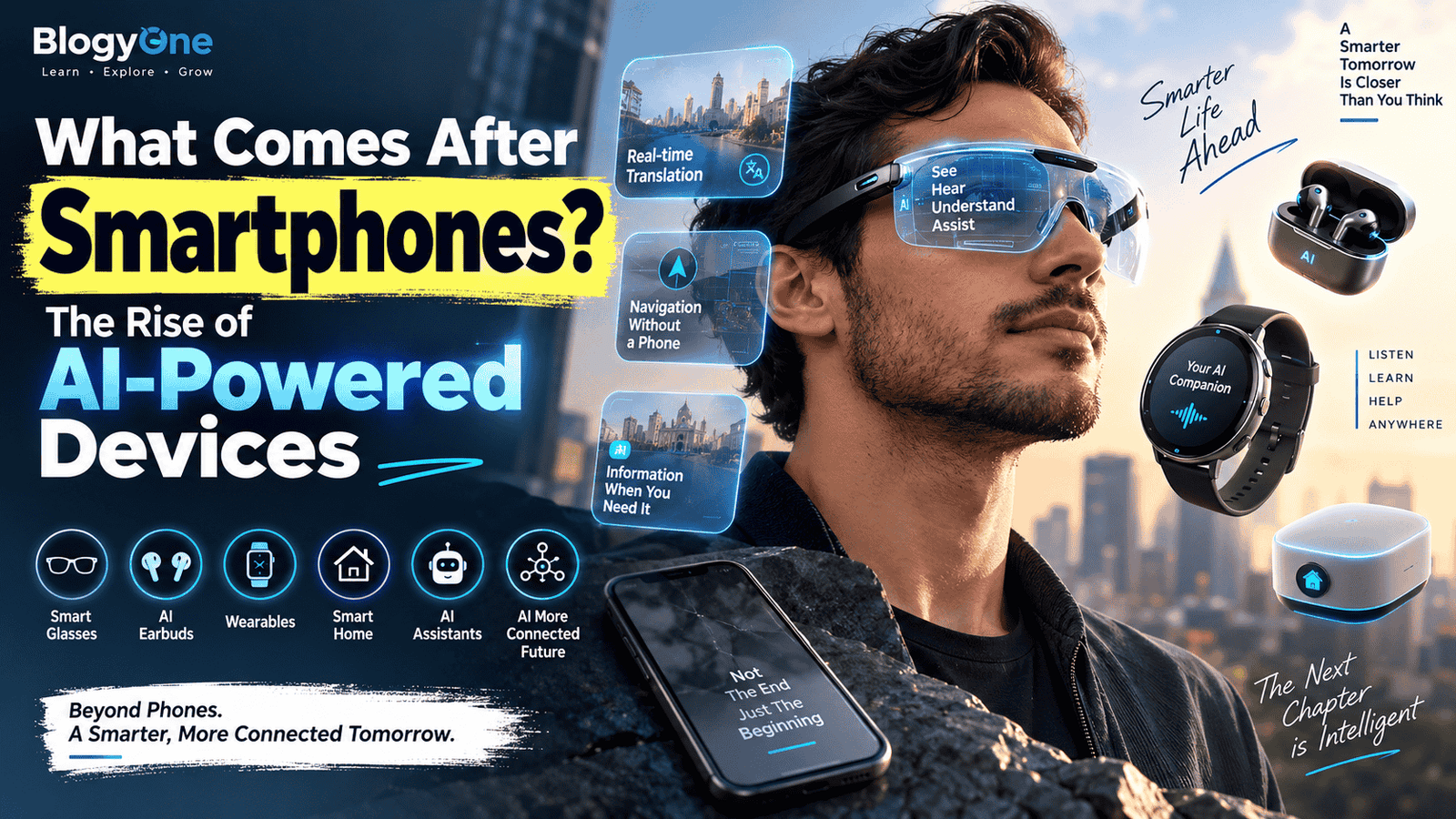
For more than a decade, the smartphone has been the center of personal technology. We use it to communicate, take photos, navigate, work, study, shop, watch videos, manage finances, and access information. But the next major shift in consumer technology may not be about making smartphones even more powerful. It may be about reducing how often we need to look at a screen in the first place.
This is where AI-powered devices enter the picture. Smart glasses, intelligent earbuds, wearable assistants, AI-enabled computers, and other emerging devices are beginning to move computing from our pockets into our surroundings. Instead of opening an app and searching for information, users may increasingly interact with technology through voice, vision, sensors, and context.
The transition will not happen overnight, and smartphones are unlikely to disappear anytime soon. However, the way people use personal technology could change dramatically over the coming years.
What Comes After Smartphones?
The technology that comes after smartphones is unlikely to be a single replacement device. Instead, it will probably be an ecosystem of connected devices that can understand what a person is doing and provide assistance when needed.
A smartphone requires users to initiate most interactions. You unlock it, open an application, type a request, take a picture, or search for something.
AI-powered devices aim to make that interaction more natural.
Imagine wearing lightweight glasses that can identify a landmark, translate visible text, provide navigation guidance, or help you remember where you placed something. Consider earbuds that can understand spoken requests without requiring you to pull out your phone. A computer could also use AI to organize information, summarize documents, automate repetitive tasks, and respond to natural-language instructions.
The important change is not simply more AI. It is the movement of computing from a device you actively operate toward technology that can understand context and assist you more naturally.
Why AI-Powered Devices Matter
Traditional digital devices are largely application-centered. You decide which app to open and what action to perform.
AI introduces a different interaction model: intent-centered computing.
Instead of thinking, “Which application do I need?”, a person can think, “I need to find this information,” “I want to translate this,” or “Help me organize these files.”
The device or software can then determine which capabilities are required.
This could make technology easier to use, particularly for tasks involving multiple applications or different types of information. It also creates opportunities for people who find traditional interfaces difficult to navigate.
At the same time, convenience comes with trade-offs. A device that understands its surroundings may need access to cameras, microphones, location information, or personal data. That makes privacy and user control central issues in the development of this technology.
The Main Types of AI-Powered Devices
Several categories are already shaping the post-smartphone discussion.
AI Smart Glasses
Smart glasses are among the most frequently discussed candidates for the next generation of personal computing.
Unlike a smartphone, glasses can remain available while your hands are occupied. Cameras and microphones can allow them to interpret visual and audio information, while speakers can deliver responses without requiring a screen.
Potential uses include navigation, translation, accessibility assistance, photography, reminders, and contextual information.
The biggest challenge is making these devices useful without making them distracting, uncomfortable, socially awkward, or intrusive.
AI-Powered Earbuds
Wireless earbuds have already become common, but adding more intelligent software could change their role.
Future earbuds could function as personal assistants capable of understanding conversations, translating speech, answering questions, controlling connected devices, or helping users interact with digital services.
Their advantage is simple: people are already comfortable wearing them for extended periods.
AI Wearables
Wristbands, watches, pendants, pins, and other wearable devices can collect information through sensors and provide quick interactions without requiring a traditional screen.
Their usefulness depends heavily on battery life, comfort, accuracy, privacy controls, and how effectively they complement existing devices.
The goal is not necessarily to place every smartphone function on another gadget. It is to make specific tasks faster and more natural.
AI-Enabled Computers
The smartphone is not the only device being transformed.
Laptops and desktop computers are increasingly gaining AI capabilities that can assist with writing, coding, searching, summarizing, organization, communication, and other everyday tasks.
For many users, the computer of the future may feel less like a collection of applications and more like an intelligent workspace that helps coordinate different tasks.
How AI-Powered Devices Work
AI-powered devices combine several technologies rather than relying on artificial intelligence alone.
Sensors collect information from the environment. Cameras can capture visual information, microphones detect speech and sounds, and other sensors can provide information about movement or surroundings.
On-device processing allows some tasks to happen directly on the device. This can reduce dependence on an internet connection and may improve privacy or response time for certain functions.
Cloud computing can provide additional processing power for more demanding tasks. A device may send selected information to remote servers, receive a result, and present it to the user.
AI software interprets the collected information and determines an appropriate response.
The quality of the overall experience depends on how well these components work together. A powerful AI model is not enough if the hardware is uncomfortable, the microphones are unreliable, the battery runs out quickly, or the device misunderstands the user's intent.
What Could Be Better Than a Smartphone?
The strongest argument for AI-powered devices is not that they can perform more tasks. Smartphones already perform an enormous number of tasks.
The potential advantage is less friction.
Suppose you are walking through a city and see a sign written in an unfamiliar language. With a smartphone, you might take out the phone, open an application, activate the camera, capture the sign, and read the translation.
With an appropriate AI wearable, the interaction could potentially happen through a simple spoken request while you continue walking.
Similarly, remembering information could become less dependent on manually creating notes. A device with appropriate permissions might help retrieve information from previous interactions or connected services.
For professionals, AI-enabled computers could reduce time spent searching through documents, organizing information, or performing repetitive digital tasks.
The Challenges Are Just as Important
The future of AI-powered devices is not guaranteed. Several obstacles must be solved before they can become genuinely mainstream.
Privacy
A device with cameras and microphones can potentially collect information about both the user and people nearby.
This creates difficult questions. What is recorded? Where is it processed? How long is it stored? Who can access it? Can users easily disable particular sensors?
These questions need clear answers if people are expected to trust always-available technology.
Battery Life
Small devices have limited physical space for batteries. Continuous use of cameras, microphones, wireless connectivity, and AI processing can consume significant power.
A device that needs frequent charging may be inconvenient regardless of how intelligent it is.
Accuracy
AI systems can misunderstand speech, misinterpret images, or provide incorrect information.
That becomes particularly important when a device is expected to understand its physical surroundings. Users need clear ways to recognize uncertainty and verify important information.
Social Acceptance
Technology does not become popular simply because it works.
People also need to feel comfortable using it around others. Cameras and microphones on wearable devices can raise concerns in workplaces, schools, restaurants, public spaces, and private settings.
Designers will need to consider visible recording indicators, privacy controls, social etiquette, and local rules.
Cost
New hardware, advanced sensors, processors, and AI services can make devices expensive.
For widespread adoption, the benefits will need to justify the cost for ordinary consumers, not just technology enthusiasts.
Will Smartphones Disappear?
Probably not in the near future.
Smartphones have several advantages that are difficult to replace with a single wearable. Their large displays are useful for reading, editing documents, watching videos, browsing websites, managing complex applications, and performing detailed tasks.
They also provide mature connectivity, cameras, storage, app ecosystems, and familiar interfaces.
A more realistic future is that smartphones become one part of a larger personal technology ecosystem.
You might use glasses for quick contextual information, earbuds for voice interaction, a watch for brief notifications, and a smartphone or computer when a larger screen is necessary.
In this model, the smartphone does not necessarily die. It becomes less central.
What Will the Future User Experience Look Like?
The biggest change may be invisible.
Instead of constantly switching between applications, users could interact with technology through natural requests.
A person might say:
“Find the document I worked on yesterday.”
“Translate this sign.”
“Remind me about this when I arrive at the office.”
“Summarize the messages I received this morning.”
“Show me the quickest route home.”
The device would then coordinate the appropriate services.
This approach shifts the focus from learning how software works to telling technology what outcome you want.
That could make computing more accessible, but it also means users must understand what their devices are allowed to access and how automated actions are being performed.
What Consumers Should Look For
Anyone considering an AI-powered device should look beyond impressive demonstrations.
Check whether the device has useful features that solve real problems. Battery life, comfort, software support, compatibility, privacy controls, repairability, and total cost can matter more than a long feature list.
It is also worth asking whether the device genuinely replaces a step in your daily routine or simply adds another gadget to manage.
The best technology should reduce complexity rather than create more of it.
The Bigger Shift: From Screens to Context
The most interesting possibility is that computing may become less screen-dependent.
For decades, digital interaction has revolved around keyboards, mice, touchscreens, menus, and applications. AI-powered devices could introduce a more contextual model in which technology responds to speech, vision, movement, location, and the user's immediate objective.
That does not mean screens will disappear. Screens remain extremely useful.
Instead, screens could become one interface among many.
This is similar to how cameras evolved from specialized equipment into features found inside phones. A technology does not necessarily have to vanish to become less central. Its role can simply change.
Conclusion
The question of what comes after smartphones may have the wrong assumption built into it. The future may not be defined by one device replacing another. Instead, personal computing is likely to become more distributed across glasses, earbuds, watches, computers, smartphones, and other connected devices.
AI could make these devices more capable of understanding natural language, interpreting surroundings, and helping with everyday tasks. But technical capability alone will not determine their success. Privacy, battery life, accuracy, affordability, reliability, and social acceptance will be just as important.
For consumers, the most useful future device will not necessarily be the one with the most impressive specifications. It will be the one that quietly removes friction from everyday life while giving the user clear control over their information.
The smartphone era may not end with a dramatic replacement. It may gradually evolve into something broader: a world where computing is always available, but increasingly less visible.
Comments (0)
No comments yet. Be the first to share your thoughts!
Join the Conversation
Share your perspective, ask questions, and connect with other readers on this story.