
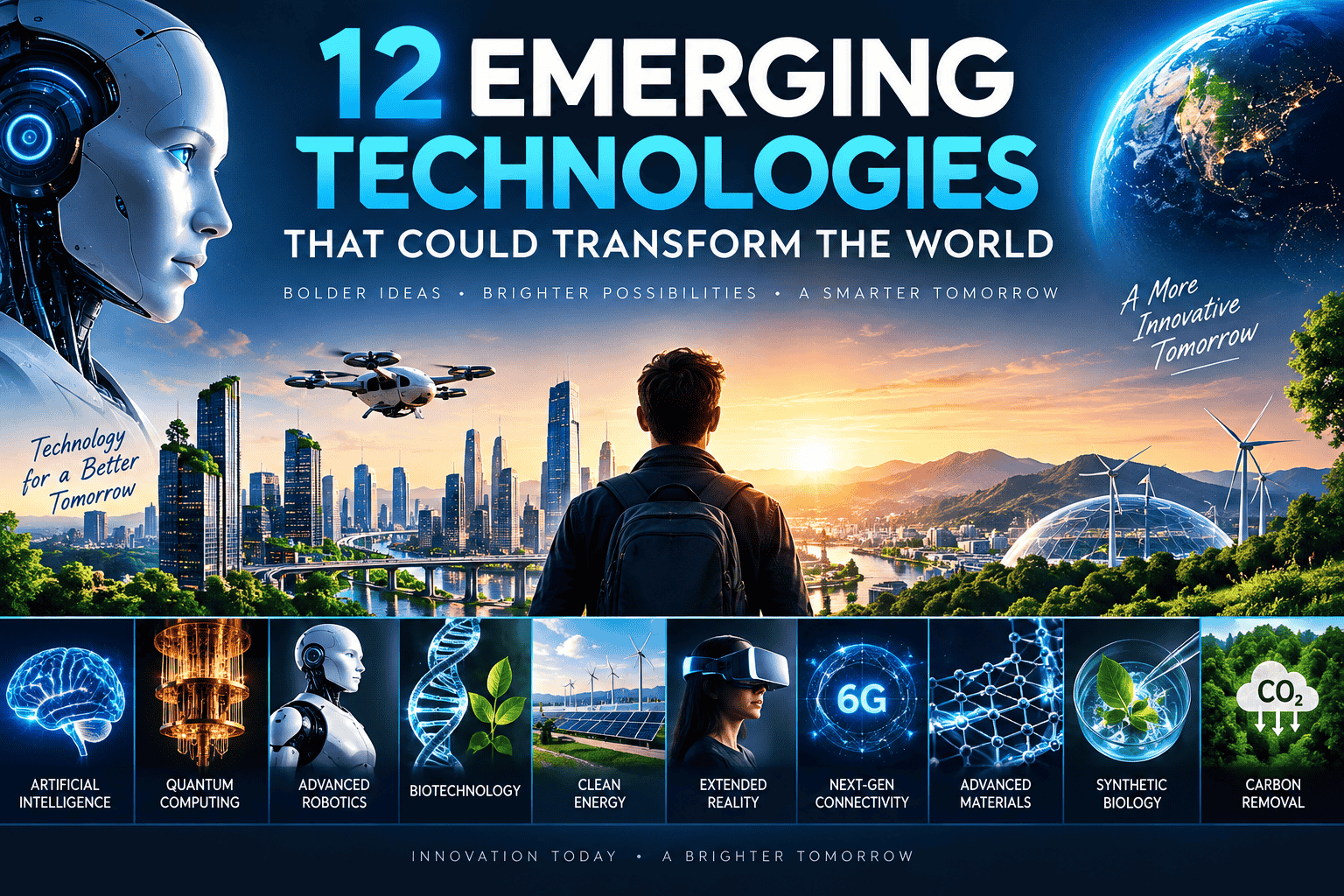
Technology rarely changes the world through a single invention. More often, transformation happens when several breakthroughs mature at the same time and begin solving problems that once seemed too expensive, slow, or difficult to tackle. The emerging technologies discussed in this article could influence how people work, communicate, travel, produce energy, manage healthcare, and interact with the physical world.
Some of these technologies are already moving from research laboratories into practical products and services. Others remain experimental and face major technical, economic, regulatory, or ethical challenges. Understanding both their potential and their limitations is essential because technological progress is rarely as simple as a new invention becoming universally useful overnight.
Artificial Intelligence and Autonomous Systems
Artificial intelligence has already moved beyond simple automation. Modern AI systems can analyze large datasets, recognize patterns, generate content, assist with programming, interpret images, and support decision-making across many industries.
The next stage is likely to involve more capable autonomous systems that can complete sequences of tasks rather than performing only one isolated function.
Where AI could have the greatest impact
Healthcare could benefit from systems that help analyze medical images, identify patterns in patient data, or support clinical research. In manufacturing, AI can optimize production processes and predict equipment failures. In transportation, increasingly sophisticated software could improve navigation, traffic management, and vehicle automation.
The biggest challenge is not simply making AI more capable. Reliability, privacy, cybersecurity, transparency, employment effects, and appropriate human oversight will determine how successfully these systems are adopted.
AI is therefore one of the most influential emerging technologies, but its long-term value will depend heavily on how responsibly it is integrated into society.
Quantum Computing
Traditional computers process information using bits represented as zeros and ones. Quantum computers use quantum states to perform certain types of calculations in fundamentally different ways.
Quantum computing is not expected to replace ordinary computers for everyday tasks. Its potential lies in specialized problems where quantum algorithms could offer advantages over conventional approaches.
Potential applications
Researchers are exploring quantum computing for areas such as:
· Molecular and materials simulation
· Drug discovery
· Optimization problems
· Cryptography
· Financial modeling
· Complex scientific calculations
The technology remains difficult to build and operate. Quantum systems are highly sensitive to environmental disturbances, and maintaining reliable quantum states is a major engineering challenge.
If those obstacles can be overcome at scale, quantum computing could become one of the most consequential emerging technologies for science and industry.
Advanced Robotics
Robots are becoming more adaptable. Instead of being limited to repetitive factory movements, newer robotic systems are being designed to perceive their surroundings, manipulate different objects, navigate changing environments, and work alongside people.
This could expand robotics into warehouses, hospitals, agriculture, construction, logistics, and domestic environments.
Why adaptable robots matter
A conventional industrial robot may perform one task extremely well but struggle when its environment changes. More flexible robots could handle a wider variety of jobs without requiring extensive reprogramming.
Humanoid robots are also attracting attention because their physical form is compatible with environments designed for humans, such as stairs, doors, shelves, and tools.
However, practical deployment requires more than impressive demonstrations. Robots need to be reliable, safe, affordable, energy-efficient, and capable of operating for long periods without constant supervision.
Brain-Computer Interfaces
Brain-computer interfaces, often called BCIs, create communication pathways between neural activity and external devices.
The most immediate value may come from medical applications. A person who has lost certain physical abilities could potentially use neural signals to control a computer, robotic device, or communication system.
Beyond medical rehabilitation
Longer-term possibilities include more direct interaction between humans and digital systems. Researchers are investigating ways to improve signal quality, reduce invasive procedures, and make interfaces easier to use.
The technology also raises difficult questions about privacy and ownership of neural information. Brain data is particularly sensitive because it could reveal information about a person's physical condition or cognitive activity.
For that reason, the development of BCIs will require technical progress alongside strong ethical and privacy protections.
Biotechnology and Gene Editing
Biotechnology is changing how scientists approach diseases, agriculture, food production, and biological research. Gene-editing techniques can allow researchers to make targeted changes to DNA, creating possibilities that were previously difficult or impossible.
Medical possibilities
Researchers are investigating gene-based approaches for inherited diseases, cancer, immune disorders, and other conditions. In agriculture, biotechnology may help develop crops with useful characteristics such as improved resistance to environmental stress.
The opportunities are significant, but biological systems are complex. Changing one genetic element can sometimes produce unexpected effects, and clinical applications require extensive testing and oversight.
Gene editing is therefore best understood as a powerful tool rather than a universal solution.
Advanced Energy and Next-Generation Batteries
The transition toward cleaner energy depends not only on generating electricity but also on storing it efficiently.
Lithium-ion batteries have enabled smartphones, laptops, electric vehicles, and large-scale energy storage. Researchers are now investigating alternatives that could improve energy density, charging speed, safety, cost, or material availability.
What better batteries could change
More capable energy storage could make renewable electricity easier to integrate into power networks because stored electricity can help balance periods when solar or wind generation is low.
Improved batteries could also make electric vehicles more practical by reducing charging time or increasing usable range.
Technologies under investigation include solid-state batteries, sodium-ion systems, lithium-metal designs, and other advanced chemistries. Each approach involves trade-offs involving cost, manufacturing complexity, durability, materials, and performance.
Fusion Energy
Fusion seeks to generate energy by combining light atomic nuclei under extremely demanding conditions. The same broad physical process powers the Sun.
Unlike conventional nuclear fission, fusion does not rely on splitting heavy atomic nuclei. Researchers are working on different approaches to create and sustain the conditions necessary for controlled fusion reactions.
Why fusion attracts so much attention
A successful commercial fusion system could potentially provide large amounts of low-carbon energy using widely available fuel inputs.
But producing fusion reactions in a laboratory is not the same as operating a commercially viable power plant. Engineers still face major challenges involving plasma control, materials, heat management, maintenance, and economic efficiency.
Fusion is therefore a technology with potentially enormous consequences, but its commercial future remains dependent on continued technical progress.
Extended Reality and Spatial Computing
Virtual reality, augmented reality, and mixed reality are gradually changing how digital information can be experienced.
Instead of displaying information only on a flat screen, spatial computing can place digital objects, instructions, or interactive environments within a user's physical surroundings.
Practical uses beyond entertainment
Businesses could use spatial systems for employee training, equipment maintenance, product visualization, and remote collaboration. Students could explore three-dimensional scientific or historical environments rather than relying entirely on two-dimensional materials.
For these technologies to become mainstream, devices will need to become lighter, more comfortable, more affordable, and easier to use for extended periods.
The long-term opportunity is not simply replacing smartphones with headsets. It is creating new ways for digital information to interact with physical spaces.
6G and Next-Generation Connectivity
Mobile networks continue to evolve as demand for connected devices, cloud services, autonomous systems, and real-time applications grows.
6G research explores communication systems that could eventually offer capabilities beyond those associated with current mobile networks. Potential areas include extremely low-latency communication, highly intelligent network management, sensing capabilities, and stronger integration between communication and computing.
A more connected physical world
Future networks could support large numbers of connected sensors and machines in factories, cities, transportation systems, and other environments.
However, faster connectivity alone does not guarantee useful innovation. Infrastructure costs, spectrum availability, cybersecurity, energy consumption, device compatibility, and global standards will all influence adoption.
Advanced Materials and Nanotechnology
Many technological limitations ultimately come down to materials. A battery may need a better electrode. A spacecraft may require lighter structures. A medical implant may need a stronger or more biocompatible surface.
Nanotechnology focuses on manipulating materials and structures at extremely small scales, while advanced materials research seeks new combinations and properties.
Where advanced materials could matter
Potential applications include:
· More efficient energy storage
· Lightweight transportation components
· Improved medical implants
· Stronger construction materials
· Advanced electronics
· More efficient solar technologies
Materials breakthroughs can have effects far beyond a single product because the same material may be useful across several industries.
Synthetic Biology
Synthetic biology applies engineering principles to biological systems. Rather than only observing how organisms work, researchers can design or modify biological components for specific purposes.
Potential applications include producing chemicals with biological systems, developing new materials, improving agricultural processes, and creating biological methods for manufacturing.
The importance of biological manufacturing
Biological systems can sometimes produce complex substances under conditions that differ significantly from conventional industrial processes.
The challenge is controlling biological systems reliably and economically at commercial scale. Safety, environmental effects, regulation, and manufacturing consistency also matter.
Synthetic biology could eventually blur the boundary between biotechnology and manufacturing, turning biological processes into platforms for producing useful materials and products.
Carbon Removal and Climate Technologies
Reducing greenhouse-gas emissions remains central to addressing climate change, but some researchers are also exploring technologies designed to remove carbon dioxide from the atmosphere or capture it from industrial processes.
Approaches include direct air capture, enhanced mineralization, bio-based carbon removal, and other methods.
Why carbon removal is difficult
Removing carbon dioxide is generally more complicated than avoiding an emission in the first place. Systems require energy, infrastructure, suitable materials, or land, depending on the approach.
The effectiveness of a carbon-removal method also depends on how much carbon it removes, how long that carbon remains stored, and the total environmental cost of the process.
Climate technologies should therefore be evaluated using complete life-cycle assessments rather than focusing on a single headline figure.
What Will Determine Which Technologies Succeed?
Not every promising invention becomes a successful technology. A breakthrough must usually pass through several stages before it becomes widely useful.
Cost
A technology can work perfectly in a laboratory and still fail commercially if producing it is too expensive.
Infrastructure
Electric vehicles, renewable power, advanced networks, and many other technologies depend on supporting infrastructure. Adoption can remain slow when that infrastructure is missing.
Reliability
Consumers and businesses generally need systems that work consistently, not just impressive demonstrations.
Regulation and public trust
Technologies involving health, genetics, personal data, autonomous machines, or neural information require appropriate safeguards. Public acceptance can strongly influence adoption.
Integration with existing systems
The most successful technologies often improve what already exists rather than requiring society to rebuild everything from scratch.
This is why the future of emerging technologies will not be determined by technical capability alone. Economics, infrastructure, regulation, usability, and social acceptance will be equally important.
Conclusion
The most significant emerging technologies may not be the ones that attract the most attention today. Their real influence will become visible when they move from demonstrations and research projects into dependable systems that solve everyday problems.
Artificial intelligence, quantum computing, robotics, biotechnology, advanced batteries, fusion, spatial computing, next-generation connectivity, advanced materials, synthetic biology, and climate technologies all have different levels of maturity and different obstacles to overcome.
The important lesson is to look beyond the excitement surrounding a new invention. Ask what problem it solves, whether it can be deployed affordably, what limitations remain, and how it could interact with other technologies.
The future will likely be shaped not by one breakthrough but by combinations of emerging technologies that reinforce one another and gradually change how society operates.
Comments (0)
No comments yet. Be the first to share your thoughts!
Join the Conversation
Share your perspective, ask questions, and connect with other readers on this story.