
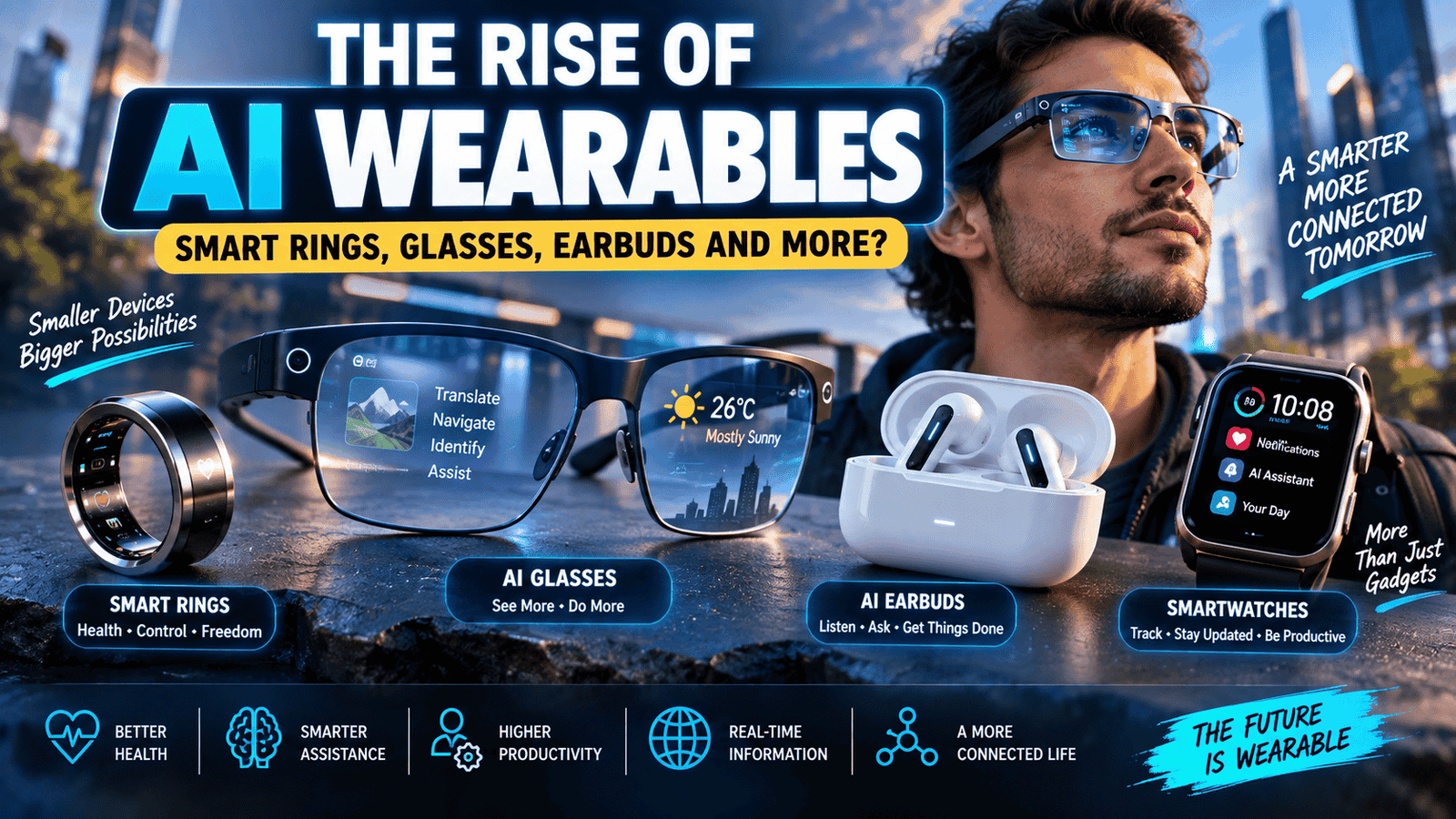
The next major shift in personal technology may not come from another smartphone. AI wearables are beginning to move computing into objects people already wear every day, including glasses, rings, earbuds, watches, and other compact devices. Instead of reaching for a screen whenever you need information, communication, or assistance, wearable technology can make those interactions more immediate and less dependent on a traditional display.
This change is bigger than adding intelligent features to accessories. It represents a different approach to computing: technology that stays with you, observes relevant context, responds through natural interfaces, and can potentially reduce the number of times you need to stop what you're doing to use a phone.
But not every wearable will become essential. Small hardware brings difficult trade-offs involving battery life, comfort, privacy, connectivity, accuracy, and usefulness. The real question is which types of AI wearables can solve everyday problems well enough to become part of normal life.
What Are AI Wearables?
AI wearables are electronic devices designed to be worn on the body while providing intelligent, connected, or context-aware functions.
Traditional wearables already perform many useful tasks. Smartwatches can display notifications, track activity, handle calls, and run applications. Wireless earbuds can play audio and provide microphones for calls. Smart rings can collect certain measurements and provide simple controls or notifications.
Adding intelligent software changes how these devices can be used.
From accessories to interfaces
A conventional accessory usually performs a narrow function. A pair of earbuds plays audio. A watch displays information. A ring may track selected measurements.
AI-enabled devices can potentially become more flexible.
An earbud could become a conversational interface. Glasses could provide visual assistance. A ring could act as a subtle control mechanism. A watch could interpret information and deliver a useful summary rather than simply displaying a notification.
The important distinction is that the device becomes capable of helping the user accomplish a task rather than merely recording or displaying data.
AI wearables can use multiple inputs
Depending on the device, wearable systems can work with combinations of:
- Voice and spoken commands
- Cameras and visual information
- Motion and movement
- Touch and gestures
- Location information
- Device sensors
- Audio
- Data from connected smartphones or online services
This combination makes wearables particularly interesting because they can interact with information about the user's immediate situation.
For example, earbuds already know that they are being worn and can capture speech through microphones. Glasses can potentially understand what the wearer is looking at. A ring can detect physical interaction through movement or touch.
Why AI Wearables Are Becoming More Important
Smartphones succeeded because they put a powerful computer into people's pockets. Wearables approach the same problem from a different direction: make computing available without requiring users to constantly hold a device.
Computing becomes more immediate
Consider a simple situation: you're walking through an unfamiliar area and need directions.
With a smartphone, you take it out, unlock it, open a map, look at the screen, and follow the route.
With suitable wearable hardware, some of that interaction could happen through audio or visual guidance while you continue looking ahead.
The difference may seem small, but repeated small conveniences can significantly change how technology fits into daily routines.
Screens are not always the best interface
Screens are excellent when you need to read, compare, edit, watch, or manipulate detailed information.
They are less convenient when your hands are occupied.
Cooking, cycling, traveling, repairing equipment, exercising, shopping, and working can all create situations where pulling out a phone is inconvenient.
This is one reason AI wearables could complement smartphones rather than immediately replace them.
Wearables can stay with the user
A phone spends much of its time in a pocket, bag, or on a desk.
Wearable devices can remain physically connected to the user throughout the day. That creates opportunities for more immediate interactions and continuous access to selected information.
The challenge is ensuring that this constant availability is useful rather than distracting.
Smart Rings, Glasses and Earbuds: What Each Device Does Best
Not all wearable devices should be expected to perform the same job. Their physical form determines what they can realistically do.
Smart rings
Smart rings are among the smallest wearable computers.
Their strength is subtlety. A ring can remain on the finger throughout the day without requiring the user to hold anything.
Potential uses include:
- Activity and movement tracking
- Selected wellness-related measurements
- Sleep-related tracking on supported devices
- Simple gestures or controls
- Notifications through connected systems
- Authentication or device control in certain ecosystems
The limitation is obvious: a ring has almost no room for a display, speaker, or large battery.
That makes it more suitable as a sensor and control device than as a complete computing platform.
AI glasses
Glasses have a much more ambitious role.
Because they sit in front of the eyes and near the ears, they can combine cameras, microphones, speakers, and potentially displays in a single wearable form.
Possible applications include:
- Hands-free photography
- Voice-based assistance
- Navigation
- Translation
- Visual recognition
- Audio communication
- Contextual information
- Hands-free access to digital services
The major attraction is that glasses can potentially connect digital information with the physical world around the wearer.
Their biggest obstacles include battery capacity, weight, appearance, privacy, heat management, and social acceptance.
AI earbuds
Earbuds may become one of the most practical AI interfaces because people are already comfortable wearing them.
They already contain microphones, speakers, processors, and wireless connectivity. Adding intelligent capabilities can turn them into conversational devices that users interact with naturally through speech.
Possible applications include:
- Voice-based questions
- Translation
- Call assistance
- Summarizing spoken information
- Personalized audio
- Navigation instructions
- Controlling connected devices
Earbuds also have a major advantage over glasses: audio can provide information privately without requiring a visible screen.
Smartwatches and other wearables
Smartwatches remain useful because they provide a small but visible interface directly on the wrist.
They can act as a bridge between a smartphone and other wearables, handling quick interactions while leaving more demanding tasks to larger devices.
Other emerging wearable concepts could include intelligent pendants, clip-on devices, fitness equipment, clothing with embedded sensors, and specialized devices for professional environments.
The long-term market may therefore consist of many different wearable forms rather than one universal product.
How AI Changes the Role of Wearable Devices
The biggest change isn't simply better hardware. It is the move from command-based computing toward context-aware assistance.
From apps to conversations
Traditional software often requires users to know which application to open.
An intelligent wearable could allow a person to simply state what they need.
For example:
"Remind me to call Sarah when I arrive home."
Instead of navigating several menus, the user could communicate the intention directly.
The exact capabilities will vary between products, but the broader idea is important: the interface becomes less dependent on traditional application navigation.
From data collection to interpretation
Wearable devices can generate large amounts of information. The harder problem is turning that information into something useful.
A device that merely records movement is less helpful than one that can organize relevant information into an understandable summary.
This could make AI wearables valuable not because they collect more data, but because they can potentially make existing data easier to interpret.
Context could become a major advantage
Imagine wearing glasses while visiting a historical site. Instead of searching manually for information about every building, a compatible system could potentially provide relevant information based on what you are looking at.
Or consider earbuds during a conversation in another language. Instead of opening a translation application, a wearable could potentially provide translated audio directly.
These examples illustrate why context matters. The device isn't merely responding to a command; it is positioned close to the situation where assistance is needed.
The Practical Benefits of AI Wearables
The usefulness of AI wearables will ultimately depend on whether they solve real problems.
Hands-free convenience
Hands-free interaction is one of the clearest advantages.
A person carrying groceries, working with tools, cooking food, or exercising may find voice and audio interfaces more convenient than a touchscreen.
Faster access to information
Wearables can reduce the number of steps required to access simple information.
Instead of taking out a phone for every small question, users could potentially ask through earbuds, glasses, or a watch.
That doesn't make the wearable more powerful than a phone. It makes the interaction more efficient.
More personalized experiences
A wearable is physically connected to its user, allowing compatible systems to incorporate information such as preferences, routines, location, or device settings.
This could support more personalized assistance, although personalization also increases the importance of privacy and user control.
Potential accessibility benefits
Wearable interfaces can provide alternatives to conventional screen interaction.
Voice, audio, visual assistance, gestures, and other interfaces may help people access information in ways that better match their individual needs.
Accessibility should be treated as a core design consideration rather than simply an additional feature.
The Challenges That Could Slow Adoption
The future of AI wearables is promising, but several practical problems remain.
Battery life and physical size
A smartphone can accommodate a relatively large battery. A ring or pair of glasses cannot.
Adding processors, cameras, sensors, wireless radios, speakers, or displays increases energy requirements while users still expect the device to remain small and comfortable.
Improving energy efficiency will therefore be essential.
Privacy
Wearables can create privacy concerns that are different from those associated with phones.
A camera on glasses, for example, can record from the user's natural viewpoint. People nearby may not always know whether they are being recorded.
Microphones create another concern, particularly when intelligent systems process conversations or environmental sounds.
Clear recording indicators, strong privacy controls, local processing where appropriate, and transparent data practices will matter greatly for public acceptance.
Accuracy and reliability
An intelligent wearable is only useful if its output is dependable.
Misunderstanding spoken instructions, incorrectly interpreting a scene, providing inaccurate information, or triggering an action at the wrong time could make a device frustrating.
Users also need to understand when a wearable is uncertain rather than treating every response as automatically correct.
Social acceptance
Technology can be technically impressive and still fail to become mainstream.
People have to feel comfortable wearing it around friends, coworkers, strangers, and in public spaces.
Appearance, etiquette, privacy signals, pricing, and cultural expectations may all influence adoption.
Information overload
Constant assistance can become annoying.
A wearable that interrupts every few minutes with notifications isn't necessarily smarter than a device that stays quiet until needed.
Good wearable design will require restraint: useful information at the right moment rather than maximum information all the time.
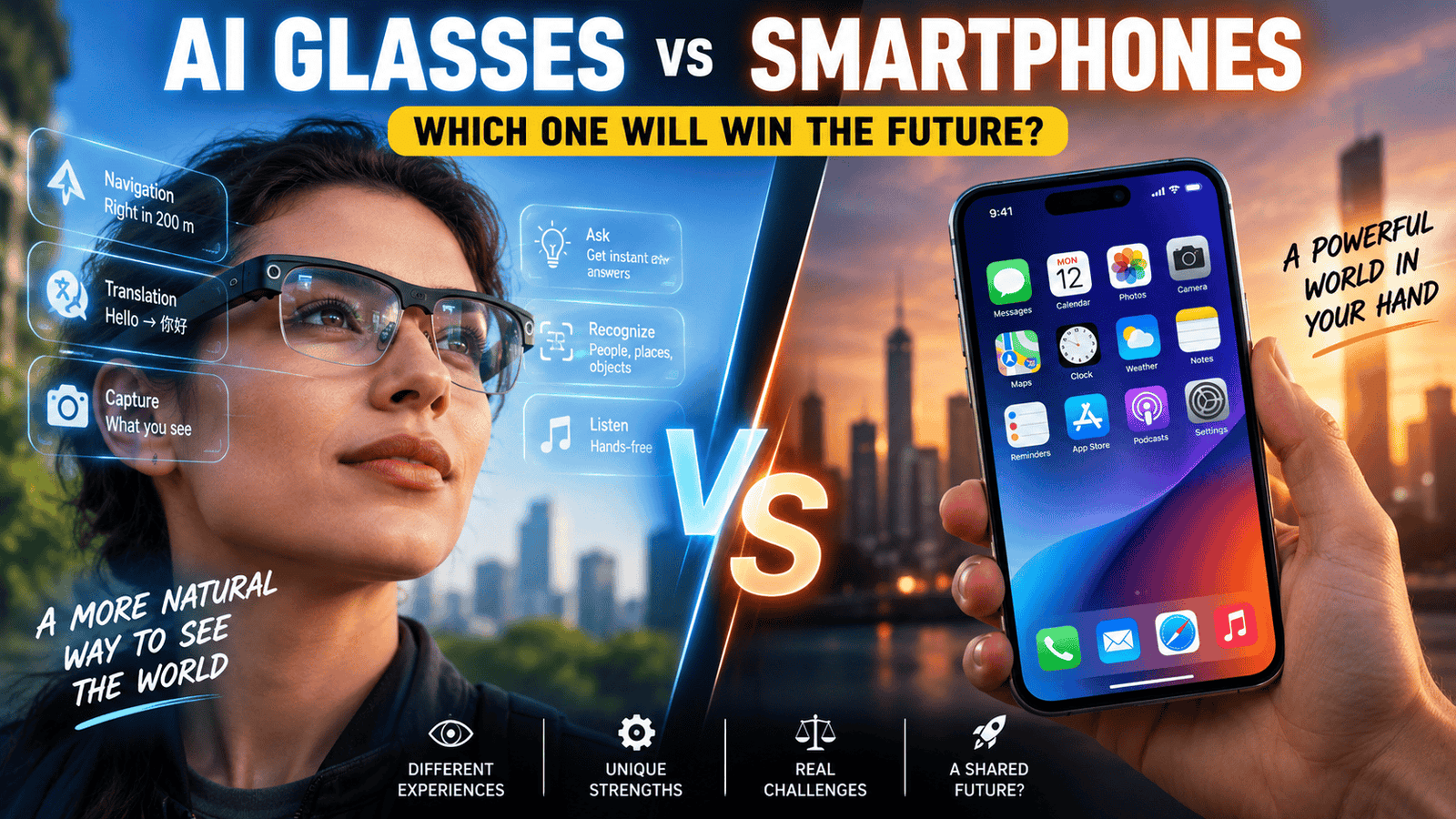
Will AI Wearables Replace Smartphones?
Probably not in the immediate future, and replacement isn't necessarily the most useful way to think about the technology.
Smartphones have several advantages that small wearables struggle to match.
Phones remain better for complex tasks
Writing long documents, editing photographs, watching detailed content, managing complicated websites, using professional applications, and performing precise touchscreen interactions are all easier on a larger display.
Wearables can handle quick interactions, but complex work still benefits from a larger interface.
The devices can complement each other
A more practical model is a connected ecosystem.
For example:
Smart ring: subtle sensing and controls
AI glasses: visual information and hands-free interaction
AI earbuds: private audio and conversational access
Smartwatch: quick information and wrist-based controls
Smartphone: complex computing and large-screen interaction
In this model, the phone remains important without being the only device through which people interact with technology.
What Could the Wearable Ecosystem Look Like?
The next stage of wearable technology may be defined by cooperation between devices.
One system, multiple interfaces
Instead of thinking about each product separately, imagine a personal technology system in which different devices share information.
You could ask a question through earbuds, see relevant information through glasses, confirm something on a watch, and use a smartphone when detailed interaction is required.
The user doesn't necessarily need to think about which device is handling the request.
Computing may become less visible
The most successful wearables may eventually become less noticeable.
People don't necessarily want to think about processors, sensors, cloud services, or connectivity. They want technology to perform a useful task when required and remain unobtrusive the rest of the time.
This could lead to a shift from device-centered computing toward environment-centered computing, where different devices work together around the user.
What consumers should look for
Anyone considering an AI-enabled wearable should look beyond the feature list.
Useful questions include:
- What problem does the device actually solve?
- How long does the battery last under normal use?
- Does it require a smartphone?
- What information does it collect?
- Where is that information processed and stored?
- Can the device's intelligent features work without an internet connection?
- How easy is it to control notifications and permissions?
- Is it comfortable enough for everyday use?
- Does the device work with the ecosystem you already use?
- Are its key features genuinely useful or simply impressive demonstrations?
These questions can help separate practical value from novelty.
Conclusion
The rise of AI wearables is not simply about putting more technology into smaller objects. It is about changing how people interact with digital services.
Smart rings can provide discreet sensing and controls. Glasses can connect digital information with the visual world. Earbuds can turn audio into a conversational interface, while watches continue to provide quick information from the wrist. Each form has different strengths and limitations.
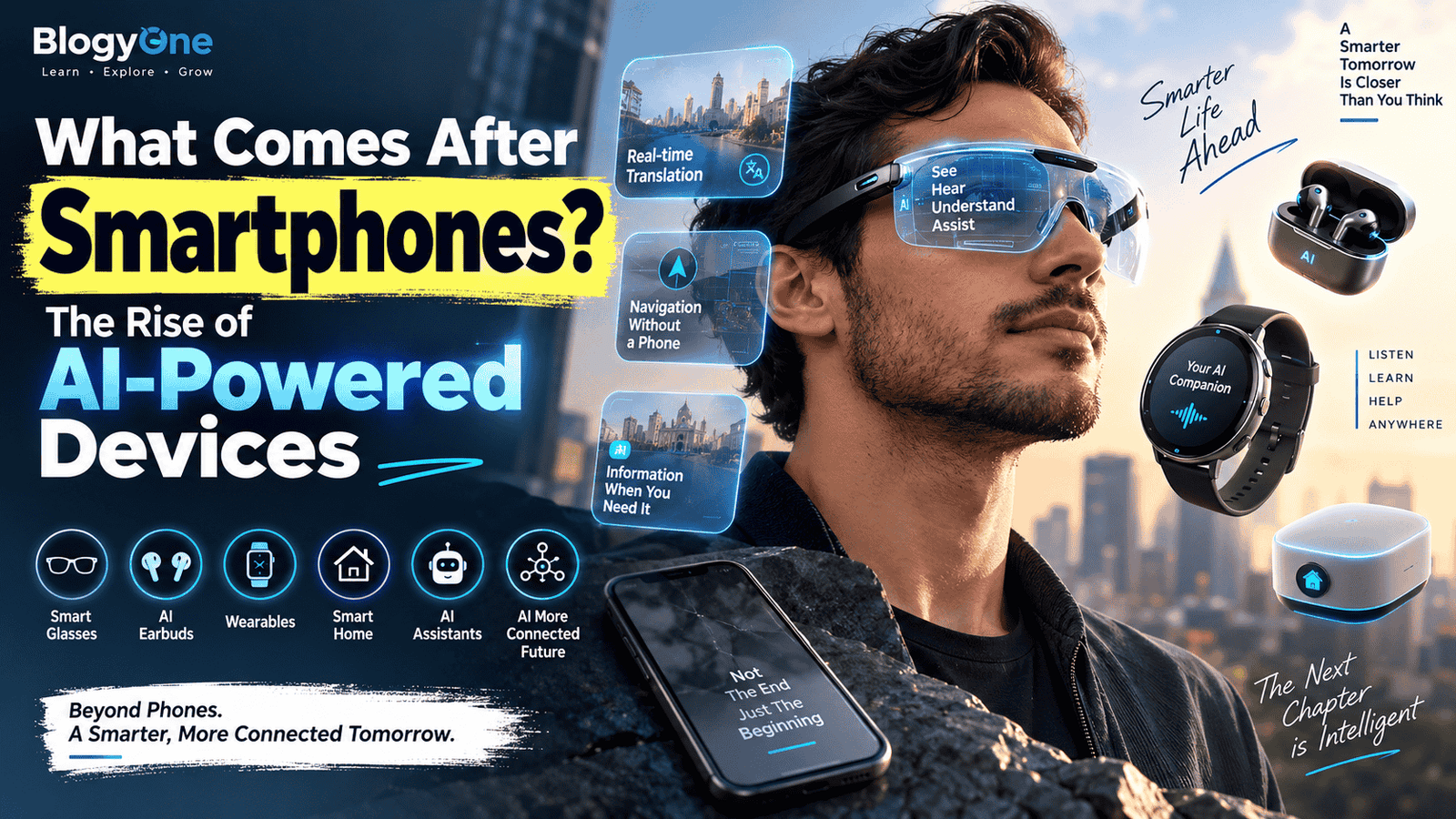
The biggest opportunity lies in making these devices work together. Smartphones are unlikely to become irrelevant simply because wearables become smarter. Instead, phones may increasingly serve as powerful computing hubs while smaller devices handle quick, contextual interactions.
The success of AI wearables will ultimately depend on practical factors: comfort, battery life, privacy, reliability, affordability, and whether the technology genuinely saves time or reduces friction.
The future may not be about choosing one wearable device. It may be about building a personal technology ecosystem in which the right device quietly handles the right task at the right moment.

Comments (0)
No comments yet. Be the first to share your thoughts!
Join the Conversation
Share your perspective, ask questions, and connect with other readers on this story.