
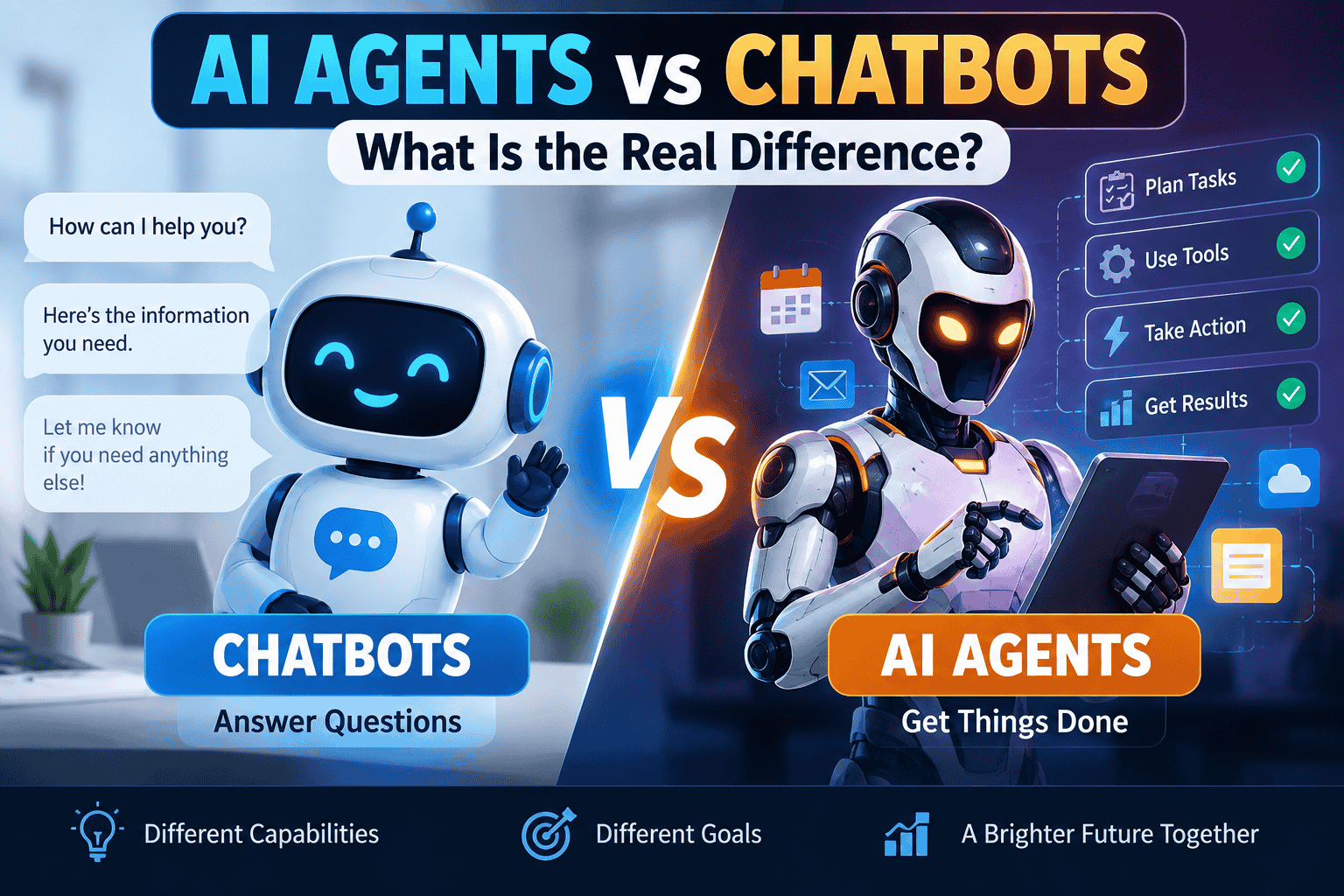
A chatbot can answer a question in seconds, but an AI agent can go several steps further by deciding what needs to happen and carrying out the work. That difference is at the heart of AI Agents vs Chatbots, a distinction that matters as businesses and individuals increasingly use conversational software for customer support, research, productivity, and automation.
The two technologies can look similar from the outside because both may communicate through a chat window. Underneath, however, they can have very different capabilities. A chatbot is generally designed to respond to users, while an agent can be designed to pursue a goal, use tools, make decisions, and complete a sequence of actions.
Understanding that difference makes it easier to choose the right technology instead of assuming that every conversational system works in the same way.
What Are Chatbots?
A chatbot is a software system designed to communicate with people through conversation. Depending on its design, it may answer questions, provide information, guide users through predefined processes, or connect them with another service.
Traditional chatbots often rely heavily on predefined rules. For example, a customer might type "How do I reset my password?" and the chatbot identifies the relevant intent before displaying instructions.
More advanced conversational systems can interpret natural language more flexibly. They may answer questions based on a knowledge base, maintain context during a conversation, and handle a wider range of requests.
The important point is that chatbots are primarily interaction-oriented. Their main job is to communicate with the user and provide an appropriate response.
A simple chatbot might perform tasks such as:
- Answering frequently asked questions
- Providing order or account information
- Guiding customers through common procedures
- Collecting basic information
- Routing users to the appropriate department
- Helping visitors navigate a website
For these purposes, a chatbot can be efficient without needing the broader decision-making and tool-use capabilities associated with an autonomous agent.
What Are AI Agents?
An AI agent is a system designed to work toward a particular objective rather than simply respond to individual messages.
Suppose someone asks a system to organize a meeting. A basic chatbot might explain how to create a calendar event. An agent could potentially check available information, identify suitable times, interact with connected tools, create the event, and report what it completed.
This illustrates the central distinction: an agent is task-oriented rather than purely conversation-oriented.
An AI agent may combine several capabilities:
- Understanding a user's objective
- Breaking a larger task into smaller steps
- Selecting appropriate tools
- Retrieving information
- Taking actions through connected systems
- Checking intermediate results
- Adjusting its approach when circumstances change
- Returning a final result to the user
Not every system described as an "agent" has all of these capabilities. The term is used broadly, so the actual architecture matters more than the label.
AI Agents vs Chatbots: The Core Differences
The easiest way to understand AI Agents vs Chatbots is to compare what each system is expected to accomplish.
|
Capability |
Chatbot |
AI Agent |
|
Primary purpose |
Conversation and assistance |
Goal completion and task execution |
|
Typical behavior |
Responds to requests |
Plans and acts toward an objective |
|
Tool usage |
May be limited or predefined |
Often uses multiple connected tools |
|
Task complexity |
Usually simple to moderate |
Can handle multi-step workflows |
|
Autonomy |
Usually lower |
Usually higher |
|
Decision-making |
Often constrained |
Can select actions based on context |
|
Memory/context |
Depends on implementation |
May maintain task-related context |
|
Human involvement |
Often needed for complex actions |
Can automate more steps |
|
Example |
Answering a support question |
Resolving a support issue across several systems |
The distinction is not always absolute. A sophisticated chatbot may use tools, retrieve information, and perform limited actions. Likewise, an AI agent may communicate through a chatbot-style interface.
That is why the difference is better understood as a spectrum of capabilities rather than two completely separate categories.
How AI Agents Work
An agent generally follows a cycle that is more involved than simply receiving a message and producing a response.
1. Understanding the Objective
The system first interprets what the user wants to accomplish.
For example:
"Find three suitable meeting times next week and prepare invitations."
The objective is not simply to answer a question. It requires several actions.
2. Breaking the Task Into Steps
The system may divide the objective into smaller tasks, such as:
- Determine the relevant dates.
- Check calendar availability.
- Identify suitable time slots.
- Prepare invitations.
- Present or send the result.
The exact process depends on the system's architecture and permissions.
3. Selecting Tools
An agent may have access to external tools or software systems. Depending on its implementation, these could include calendars, databases, search systems, business applications, or internal company platforms.
The agent determines which available capability is relevant to the current step.
4. Executing Actions
Instead of merely telling the user what to do, the system may perform permitted actions itself.
For example, an agent connected to a customer-support platform might retrieve an order, check its status, identify the applicable procedure, and update the support ticket.
5. Evaluating the Result
Some agent systems can check whether an action succeeded and determine what to do next.
This ability to work through a sequence is one of the characteristics that separates agentic workflows from simple question-and-answer interactions.
Where Chatbots Still Make Sense
The growing interest in agents does not make conventional chatbots obsolete. Many situations do not require autonomous task execution.
A chatbot can be the better fit when users primarily need information or guided assistance.
Customer Support
A company may use a chatbot to answer questions about:
- Business hours
- Shipping policies
- Return procedures
- Product information
- Account instructions
- Frequently asked questions
If most requests have predictable answers, adding complex autonomy may provide little additional value.
Website Assistance
A website chatbot can help visitors find pages, understand services, or navigate common processes without requiring access to sensitive systems.
Educational Assistance
A conversational system can explain concepts, answer questions, provide examples, and guide learners through material. The emphasis here can remain on interaction rather than autonomous execution.
Controlled Business Workflows
Some organizations deliberately keep automated systems constrained. A chatbot that retrieves information but cannot modify customer records may reduce the consequences of an incorrect action.
Where AI Agents Are More Useful
Agents become particularly useful when a task involves multiple steps, decisions, and software systems.
Research Workflows
Instead of answering one question, an agent may be designed to gather information from several permitted sources, organize findings, compare information, and produce a structured result.
Administrative Tasks
Consider a workflow involving incoming applications. An agent could potentially extract information from documents, classify submissions, check required fields, update an internal system, and flag exceptions for human review.
Software and IT Operations
Agentic systems can assist with troubleshooting by examining relevant information, identifying possible causes, performing approved diagnostic actions, and escalating unresolved problems.
Business Processes
Companies can use agent-style automation for repetitive workflows involving multiple applications. The benefit comes from reducing manual handoffs between separate steps.
The key question is not whether an agent sounds more advanced. It is whether the task actually benefits from planning and action.
Benefits and Limitations of Both Approaches
The AI Agents vs Chatbots comparison becomes more useful when capabilities are considered alongside their trade-offs.
Advantages of Chatbots
Chatbots can offer:
- Simpler implementation
- Predictable interaction patterns
- Easier control over permitted actions
- Fast responses to routine questions
- Straightforward customer-facing experiences
Their narrower scope can also be an advantage when reliability and control matter more than autonomy.
Limitations of Chatbots
A chatbot may struggle when a request requires several actions across different systems. Users may end up receiving instructions instead of having the task completed.
A highly constrained chatbot can also become frustrating when customers repeatedly encounter predefined responses that do not address unusual situations.
Advantages of AI Agents
Agents can potentially:
- Automate multi-step workflows
- Coordinate information across tools
- Reduce repetitive manual work
- Adapt actions to changing circumstances
- Handle objectives rather than isolated questions
For complex processes, this can make automation considerably more useful.
Limitations of AI Agents
Greater autonomy introduces additional challenges.
An agent may have access to sensitive information or systems where an incorrect action could create real consequences. Tool permissions, authentication, monitoring, human approval, error handling, and auditability therefore become important.
An agent should not automatically receive permission to perform every action it can technically access.
A practical design often separates low-risk actions from high-impact actions. For example, an agent might be allowed to prepare a transaction for review but require human approval before actually submitting it.
Real-World Examples
Consider three different situations.
Example 1: Restaurant Website
A visitor asks, "What time do you close tonight?"
A chatbot can answer directly. There is little reason to introduce a complex autonomous workflow.
Example 2: Travel Planning
A customer asks for a multi-day itinerary based on specific preferences. A more capable system could gather information, compare options, organize the itinerary, and potentially interact with booking tools if authorized.
This is closer to an agentic workflow because several related tasks must be coordinated.
Example 3: IT Support
An employee reports that they cannot access a company application.
A chatbot might provide troubleshooting instructions. An agent could potentially check approved system information, perform diagnostics, reset an authorized setting, and escalate the issue if the problem remains unresolved.
The second approach can save more manual effort, but it also requires stronger controls.
How to Choose Between an AI Agent and a Chatbot
The decision should begin with the workflow rather than the technology label.
Ask these questions:
Does the User Mainly Need Information?
If the answer is yes, a chatbot may be sufficient.
Does the Task Require Multiple Steps?
If completing the request involves several dependent actions, an agent may provide more value.
Does the System Need Access to External Tools?
If the software needs to interact with calendars, databases, business applications, or other systems, an agentic design may be appropriate.
What Happens if the System Makes a Mistake?
This is one of the most important questions.
For low-risk tasks, greater automation may be acceptable. For financial, administrative, security-sensitive, or otherwise consequential actions, additional verification and human approval may be necessary.
How Much Autonomy Is Actually Required?
More autonomy is not automatically better. A narrowly designed system can be easier to control, test, maintain, and audit.
The best architecture is therefore the one that matches the task's complexity, risk, and required level of automation.
What the Future May Look Like
The boundary between chatbots and agents is likely to become less obvious as conversational systems gain more tools and workflow capabilities.
A single interface may allow someone to ask a question, receive an explanation, request an action, approve a sensitive step, and review the final result.
This means the future may not be about choosing between two completely separate products. Instead, many systems may combine conversational interaction with increasingly capable task execution.
Even then, the underlying distinction remains useful. A system that only provides information has different design requirements from one that can independently take actions across multiple services.
As autonomy increases, areas such as permission management, monitoring, transparency, testing, security, and human oversight become increasingly important.
Conclusion
The central difference in AI Agents vs Chatbots is not simply that one is newer or more sophisticated. It is the difference between responding to a conversation and working toward an objective.
Chatbots are well suited to questions, guidance, and structured customer interactions. AI agents are designed for more complex workflows where planning, tool use, decision-making, and action can reduce manual effort.
Neither approach is universally appropriate. A simple question may need nothing more than a reliable chatbot, while a multi-step business process may benefit from an agent. The right choice depends on what the system needs to accomplish, what tools it can access, how much autonomy is appropriate, and what safeguards are required.
Understanding AI Agents vs Chatbots therefore starts with one practical question: Does the user need an answer, or do they need a task completed?
Comments (0)
No comments yet. Be the first to share your thoughts!
Join the Conversation
Share your perspective, ask questions, and connect with other readers on this story.