
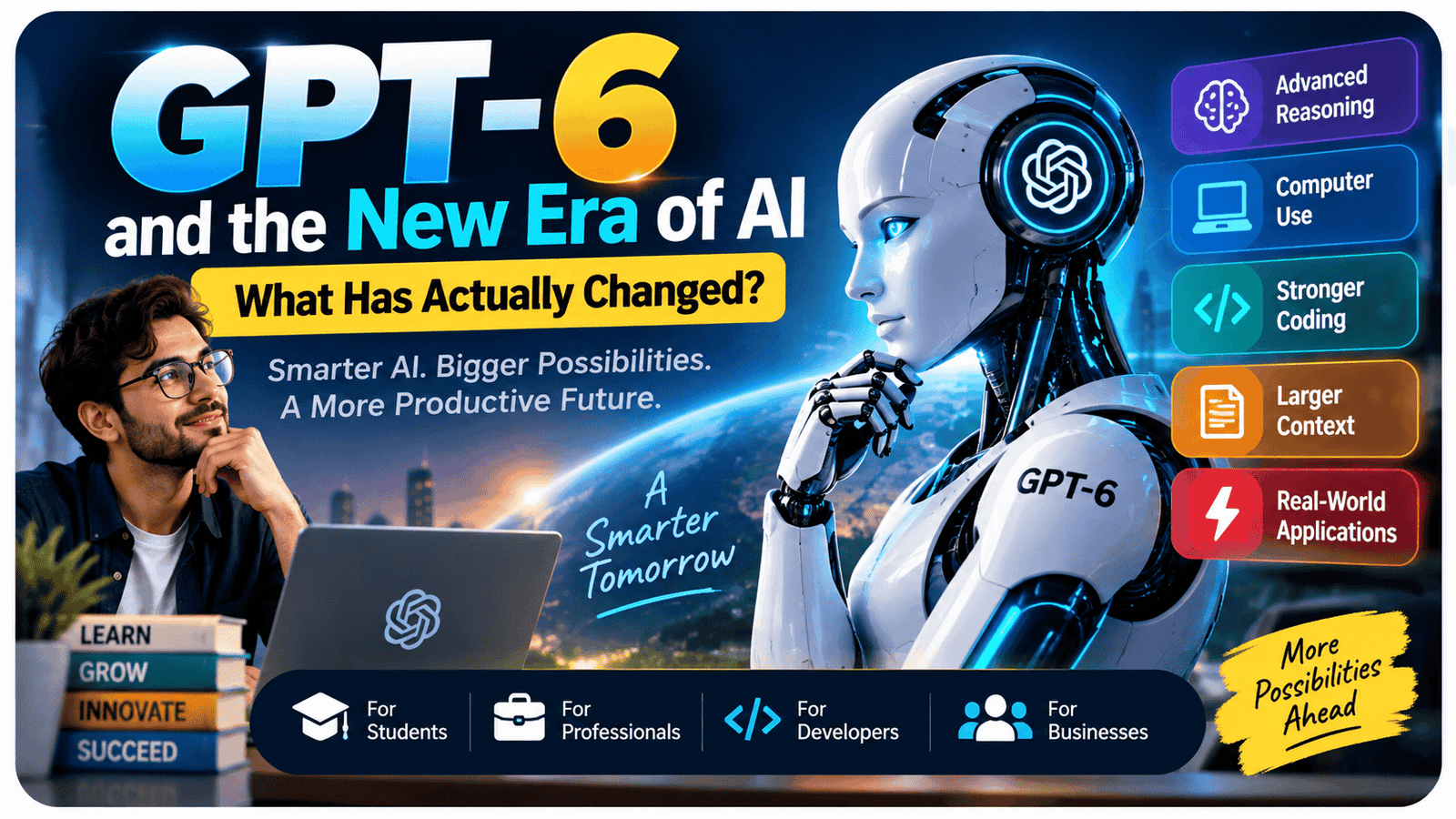
The arrival of GPT-6 marks a shift in how people think about advanced AI. The important change is not simply that a newer system can produce better answers. The bigger story is the growing ability to reason through complicated tasks, work with large amounts of information, interact with software, assist with programming, and handle longer workflows. This article looks at what has genuinely changed, what those changes mean in practical terms, and where the technology still has clear limitations.
From Better Answers to More Complete Work
For years, people mainly experienced advanced AI through a simple pattern: type a question, receive an answer, and decide what to do next.
That model is beginning to change.
The newer generation of AI systems is increasingly designed around tasks rather than isolated questions. Instead of only explaining how something works, a capable system can potentially help organize the information, analyze it, create an output, revise the result, and work through several connected steps.
Imagine someone preparing a business report.
A traditional workflow might look like this:
- Collect information manually.
- Organize the data.
- Analyze the important points.
- Write the report.
- Review the document.
- Make corrections.
A more capable AI workflow can assist with several of those stages.
The difference is significant because useful work rarely consists of one isolated question. Real projects contain dependencies. One decision affects the next, and information from one stage often becomes necessary for another.
This is where GPT-6 becomes more interesting than simply being another generation number.
From assistant to workflow partner
The emerging pattern looks more like:
Goal → information → reasoning → actions → review → result
That does not mean the human disappears from the process. In many cases, the human becomes more important for defining the goal, setting boundaries, checking important decisions, and deciding whether the final result is actually good enough.
The technology is changing the location of human effort rather than eliminating it.
GPT-6 and More Advanced Reasoning
One of the most important developments is improved reasoning.
Simple tasks do not require much reasoning. If someone asks for a definition, a short calculation, or a straightforward explanation, the answer may be relatively easy.
Complex tasks are different.
Consider debugging a large software project. The system has to understand the problem, inspect relevant parts of the code, identify possible causes, compare alternatives, make a change, and evaluate whether the change solves the original issue.
The same principle applies to research, data analysis, planning, mathematics, and technical writing.
Why reasoning matters
Better reasoning can help an AI system handle relationships between multiple pieces of information instead of treating every request as an isolated sentence.
For example, suppose a user gives three requirements:
- The project must remain within a fixed budget.
- The solution must work on existing hardware.
- The system must support future expansion.
A useful response cannot focus on just one requirement. It has to consider how the three constraints interact.
That is where stronger reasoning becomes valuable.
Reasoning is not the same as guaranteed correctness
There is an important distinction here.
A system can perform sophisticated reasoning and still reach a wrong conclusion. It can misunderstand an instruction, overlook an important detail, or make an incorrect assumption.
Better reasoning improves capability, but it does not remove the need for verification.
For important work, users should still check calculations, facts, technical decisions, and other consequential outputs.
Computer Use Is Becoming a Core Capability
One of the biggest changes in the new generation of AI is the ability to work with computers more directly.
Instead of limiting the system to a conversation window, computer-use capabilities can allow it to interact with digital environments and perform sequences of actions.
This matters because much of modern work happens inside software.
A typical office task may involve:
- Opening documents
- Searching websites
- Working with spreadsheets
- Copying information between applications
- Organizing files
- Filling forms
- Reviewing data
- Creating reports
- Checking results
Previously, AI could help explain these tasks or generate material for them. More advanced systems can potentially participate in the workflow itself.
Why computer interaction is important
The real advantage is not clicking buttons faster.
It is the possibility of connecting reasoning with action.
For example, imagine a user asking for a comparison of information spread across several documents. A system capable of navigating those documents can potentially locate relevant material, organize it, identify differences, and prepare a structured result.
That is much closer to completing a job than simply answering a question.
However, greater access also creates greater responsibility. A system that can take actions needs appropriate permissions and boundaries. A mistake in a paragraph is one thing; a mistake made while interacting with a real account or important file can be much more consequential.
Programming Is Moving Beyond Code Suggestions
Software development is another field experiencing a major change.
Earlier AI coding assistants were particularly useful for generating functions, explaining errors, completing snippets, or suggesting improvements.
Those abilities remain useful, but the direction is broader.
A more advanced coding workflow can involve understanding a project, identifying the relevant files, modifying several components, checking for errors, and iterating on the result.
What this means for developers
A developer may spend less time writing repetitive code and more time on questions such as:
- What should the application actually do?
- How should the system be structured?
- What security risks exist?
- Which architecture is appropriate?
- How should the software be tested?
- What happens when users behave unexpectedly?
This changes the role of coding assistance.
The value is no longer limited to producing lines of code. It increasingly lies in helping move a software project from an idea toward a working implementation.
Human testing remains essential
Generated code can look perfectly reasonable while containing subtle problems.
It may fail under unusual conditions, introduce security weaknesses, conflict with an existing component, or solve the wrong problem.
For that reason, stronger coding capabilities make developers more productive, but they do not make testing and review unnecessary.
Large Context Windows Change Long Projects
Another important development is the ability to work with much larger amounts of information within a single task.
This is particularly useful for projects involving lengthy material.
Consider a large research project containing:
- Multiple reports
- Meeting notes
- Technical documentation
- Previous decisions
- Data tables
- Project requirements
- Feedback from different people
If the system can work with more of that material at once, the user does not have to repeatedly explain the same background.
Why context matters
Context is essentially working memory for a task.
When important information is available together, the system has a better opportunity to connect related details.
For example, a user could provide a long product specification and then ask for:
- Contradictions in the requirements
- Missing information
- A simplified explanation
- A testing checklist
- A summary for executives
The usefulness comes from being able to work across the same body of information rather than treating each request as completely separate.
A larger context window does not guarantee perfect understanding, though. More information can still be misunderstood or overlooked. Good organization and clear instructions remain valuable.
Speed, Efficiency, and Specialized Models
Raw intelligence is only one part of useful AI.
A system can be extremely capable, but if every small task takes too long or costs too much to process, people will not use that capability for everything.
This is why the new generation increasingly includes different model options designed around different needs.
A difficult research problem may justify a more powerful model. A simple classification task may not.
A company processing thousands of routine requests may prioritize speed and efficiency, while a research team working on a difficult technical problem may prioritize deeper reasoning.
One model does not need to do everything
This is similar to choosing software tools.
You would not normally use a professional video-editing application to rename hundreds of files. The application may be powerful, but it is unnecessary for the job.
The same principle applies to AI.
Different workloads require different balances of:
- Capability
- Speed
- Cost
- Context
- Reasoning
- Tool access
This flexibility can make advanced AI more practical for businesses and individuals.
What GPT-6 Still Cannot Do Reliably
The rapid improvement of AI can create the impression that every difficult problem has now been solved.
That is not the case.
It can still make mistakes
Even highly capable systems can produce incorrect information or misunderstand complex instructions.
Users should be particularly careful when an answer affects important business decisions, software systems, legal matters, financial choices, or other areas where an unnoticed mistake could create significant consequences.
It does not automatically understand your real objective
People often provide incomplete instructions because another human would understand the missing context.
A machine may not.
For example, saying “make this report better” leaves several questions unanswered:
- Better for whom?
- Shorter or more detailed?
- More technical or more accessible?
- More persuasive or more neutral?
- What information must remain unchanged?
Clear objectives still produce better results.
More autonomy creates more risk
When AI systems can perform actions rather than simply generate information, mistakes become potentially more consequential.
That makes permissions and supervision increasingly important.
A sensible principle is simple:
The more authority a system has, the more carefully that authority should be controlled.
How GPT-6 Could Change Everyday Work
The biggest effect may be less dramatic than a futuristic demonstration.
It could simply make many digital tasks less tedious.
For students
Students can use advanced systems to break complicated subjects into manageable concepts, generate practice questions, compare explanations, and identify areas that require additional study.
The useful approach is to treat the technology as a learning aid rather than a replacement for understanding.
For professionals
Office workers may use advanced AI for document analysis, research, data organization, meeting preparation, reports, and repetitive administrative work.
The time savings can come from reducing small tasks that individually seem insignificant but collectively consume hours.
For developers
Developers can delegate repetitive implementation, debugging assistance, documentation, testing ideas, and code analysis while concentrating more heavily on architecture and product requirements.
For small businesses
Small teams can gain access to assistance across several functions without building a large specialist department for every task.
That does not mean one person can automatically replace an entire organization. It means a small team may be able to handle a wider range of digital work with fewer repetitive bottlenecks.
The skill that becomes more valuable
As AI becomes better at execution, knowing what to ask for becomes less important than knowing what outcome you actually want.
A person who can define goals, identify constraints, judge quality, and catch mistakes can make much better use of powerful AI than someone who simply asks for generic answers.
What the New AI Era Really Means
The most meaningful change is not one particular feature.
It is the combination of several improvements happening at the same time.
AI systems are becoming better at reasoning through complicated problems. They are becoming more capable of working with software. They can handle larger bodies of information, assist with programming, and participate in multi-step workflows.
Put those capabilities together and the relationship between people and computers begins to change.
For decades, software generally waited for people to operate it.
The emerging model is different: people increasingly describe an objective, while intelligent software helps carry out parts of the process.
That does not make human judgment irrelevant. In fact, judgment becomes more valuable because someone still needs to decide what matters, what should be trusted, and what should happen next.
The new AI era is therefore less about replacing every human task and more about changing the boundary between human decision-making and computer execution.
Conclusion
The biggest change associated with GPT-6 is the movement from simple answer generation toward broader task execution.
Reasoning, computer interaction, coding assistance, large-context processing, and specialized model capabilities are coming together to make AI useful across longer and more complicated workflows.
That creates opportunities for students, developers, businesses, researchers, and everyday users. At the same time, greater capability requires better judgment, stronger verification, and sensible limits.
The most useful way to think about GPT-6 is not as a machine that knows everything. It is a more capable digital system that can help people think through problems and carry out parts of complex work.
Comments (0)
No comments yet. Be the first to share your thoughts!
Join the Conversation
Share your perspective, ask questions, and connect with other readers on this story.