
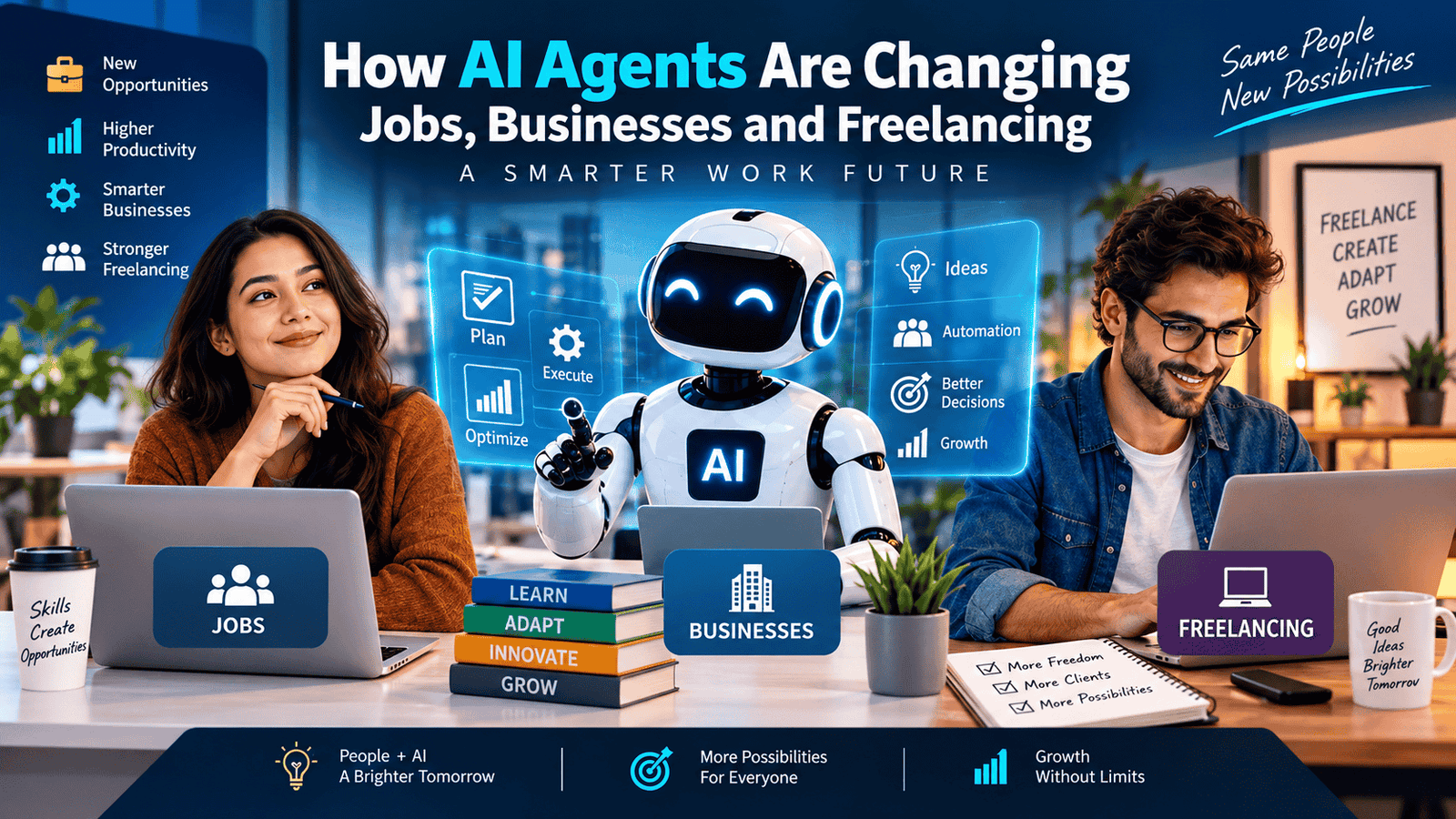
Work is moving from software that simply responds to instructions toward systems that can handle a sequence of tasks with much less supervision. AI agents are at the center of that shift, changing how companies organize work, how professionals use technology, and how freelancers deliver services. The important question is not simply whether these systems will replace jobs. It is how responsibilities will change when software can research, plan, execute tasks, and adapt along the way.
What Are AI Agents?
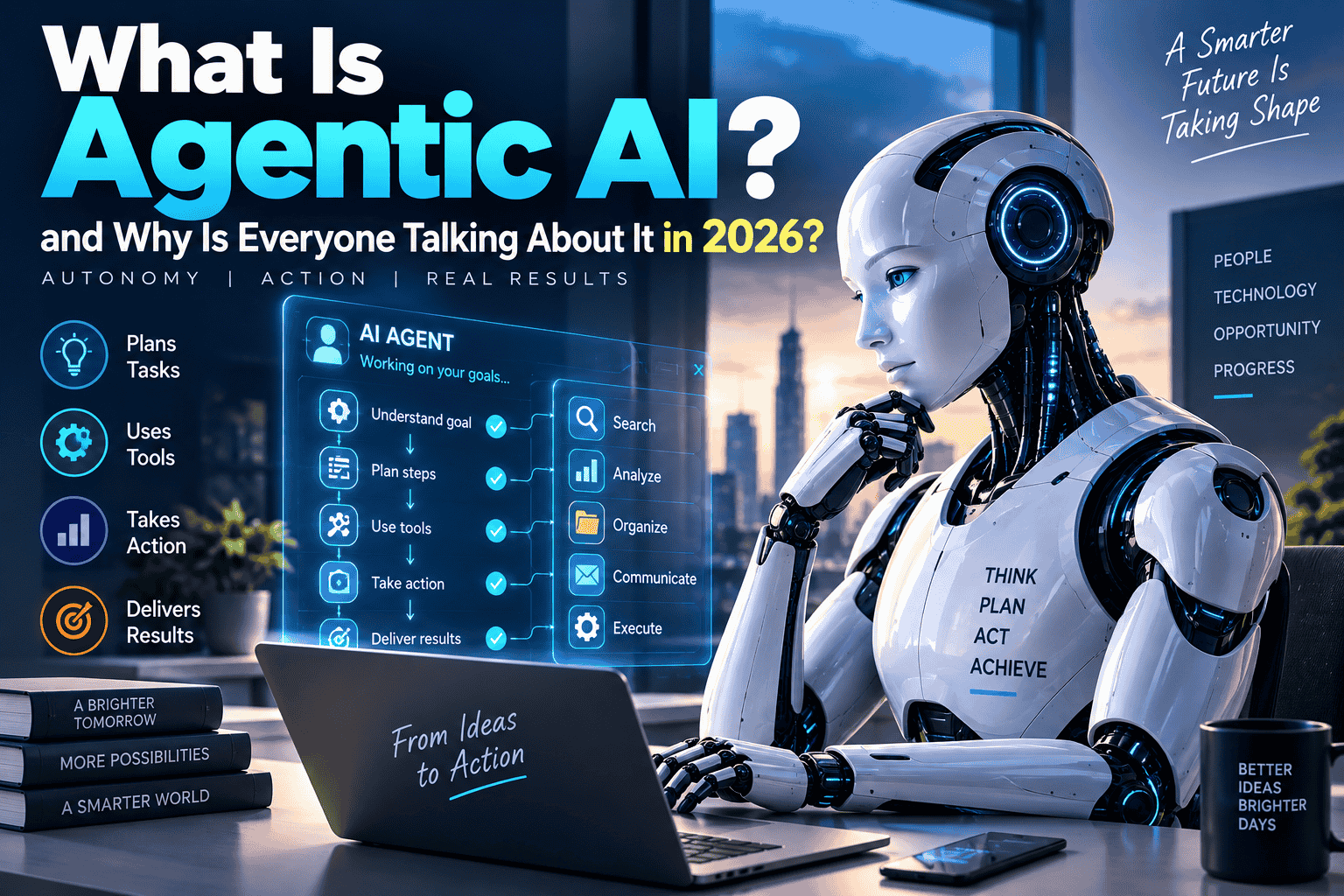
An AI agent is a software system designed to pursue a goal by performing multiple steps rather than simply producing a single response.
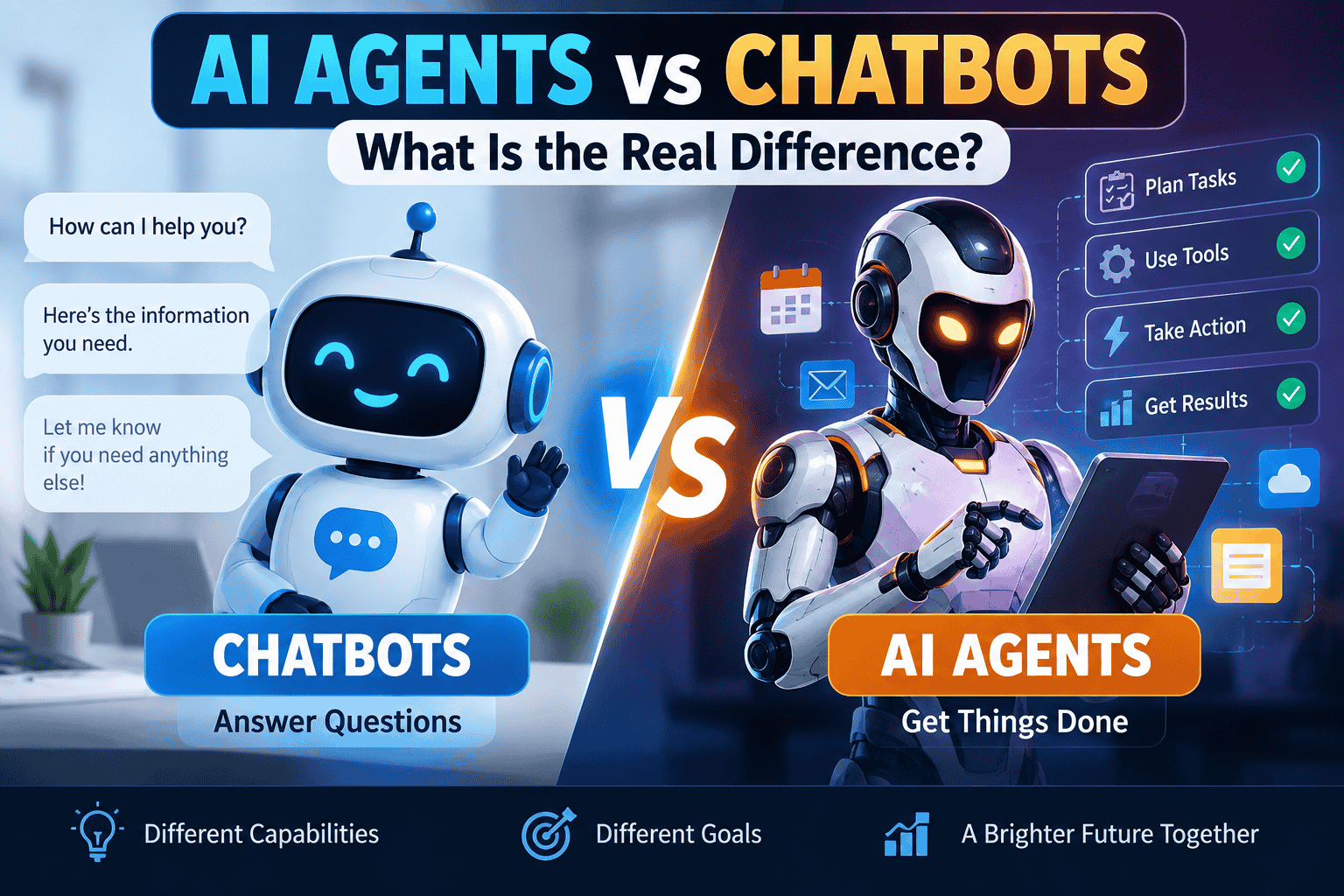
A traditional software tool usually waits for a specific command. An ordinary chatbot may answer a question, while a conventional automation might perform a predefined action when a particular condition is met.
An agent can operate across a longer workflow. Depending on its design and permissions, it may:
- Understand a goal or task
- Break the task into smaller steps
- Gather relevant information
- Use connected software or digital tools
- Make decisions within defined boundaries
- Check the results of its actions
- Continue working until the objective is completed or human input is required
For example, imagine a small business receiving dozens of customer inquiries. Instead of merely drafting replies, an agent could categorize incoming messages, identify routine requests, check information from an approved database, prepare responses, and escalate unusual cases to an employee.
The distinction matters because the value is not just in generating information. It is in completing parts of a workflow.
How AI Agents Are Changing Jobs
The effect on employment is unlikely to be identical across every profession. Some jobs contain many repetitive digital tasks, while others depend heavily on physical work, interpersonal relationships, judgment, or specialized expertise.
Routine digital work is becoming easier to automate
Many office roles include activities such as sorting information, preparing documents, transferring data between systems, scheduling meetings, producing basic reports, or monitoring routine requests.
These activities can consume substantial time even when they do not require advanced decision-making.
AI agents can potentially handle portions of this work, allowing employees to spend more time on tasks that require judgment, communication, creativity, or responsibility.
This does not necessarily mean that an entire occupation disappears. More often, individual tasks within a job may change first.
Jobs may become more supervisory
When software can complete more work independently, some employees may shift from doing every task manually to reviewing, directing, and correcting automated workflows.
Consider a marketing employee who previously spent hours collecting campaign data and preparing routine reports. With agent-based systems handling data collection and initial analysis, the employee may spend more time deciding what the findings mean and what action the company should take.
The role changes from execution alone to a combination of execution, supervision, and decision-making.
New responsibilities will emerge
Businesses adopting agent-based systems also need people who can configure workflows, establish permissions, review outputs, monitor failures, protect sensitive information, and decide when human intervention is necessary.
That creates demand for hybrid skills.
Someone does not necessarily need to become a software engineer to benefit from these changes. Understanding a business process and knowing how technology can improve it can itself become valuable.
How Businesses Are Using AI Agents
For businesses, the attraction is not simply having another productivity application. The bigger opportunity is connecting several parts of a workflow.
Customer service
An agent can help organize customer requests, retrieve approved information, classify issues, and prepare responses.
Human employees can then focus on complicated complaints, unusual cases, and situations where empathy or judgment matters.
The strongest implementations usually keep clear boundaries around what the system can decide on its own.
Sales and lead management
Sales teams often spend considerable time researching prospects, updating records, preparing follow-ups, and organizing information.
An agent can assist with these administrative activities and prepare useful context before a salesperson contacts a potential customer.
The salesperson still makes the important relationship and commercial decisions.
Operations and administration
Small companies frequently have employees performing repetitive administrative work because they lack dedicated teams for every function.
An agent can potentially coordinate tasks such as document processing, internal notifications, scheduling, information retrieval, and routine reporting.
This can be particularly useful for businesses where a small team has to manage a large number of processes.
Software and technical work
Development teams can also use agents to assist with tasks such as investigating errors, preparing code changes, writing documentation, or testing defined workflows.
Human developers remain responsible for architecture, security, code review, and decisions that carry significant technical consequences.
The broader pattern is consistent: automation becomes more useful when it is connected to a real process rather than treated as an isolated novelty.
The Growing Impact on Freelancing
Freelancing may experience one of the most visible changes because independent professionals compete largely on the basis of time, expertise, quality, and delivery speed.
AI agents can alter all four.
Freelancers can deliver more with the same amount of time
A freelance researcher, for example, might previously spend hours collecting information, organizing notes, and preparing a first draft of a report.
With suitable agent-based workflows, some of the research and organization can be accelerated. The freelancer can then spend more time checking accuracy, adding expertise, improving the presentation, and communicating with the client.
The advantage is not simply working faster. It is potentially being able to accept projects that would previously have required a larger amount of manual effort.
Low-complexity services may face greater competition
Services based mainly on repetitive digital production can become easier for clients to automate themselves.
Basic data processing, simple content variations, routine research, straightforward image modifications, and other standardized tasks may become increasingly competitive.
Freelancers who sell only the production of a basic deliverable may therefore face pressure on pricing.
Specialized expertise becomes more important
A freelancer who understands a client's industry, can solve unusual problems, and can take responsibility for the final outcome offers something more difficult to automate.
For example, a general writer might compete on producing words, while a specialist who understands a particular industry can offer research, strategic thinking, editing, fact-checking, and a finished communication product.
The deliverable becomes more valuable when it includes judgment.
Which Skills Are Becoming More Valuable?
The rise of AI agents does not make human skills irrelevant. In many cases, it increases the value of skills that automated systems cannot reliably provide without oversight.
Problem definition
An agent can work toward a goal, but someone still needs to define what success means.
A vague instruction can produce a technically impressive but commercially useless result.
Professionals who can turn a business problem into a clear process will have an advantage.
Critical thinking and verification
Automation can make mistakes quickly.
People therefore need to evaluate information, identify inconsistencies, recognize unusual situations, and verify important outputs before they are used.
The ability to check work becomes increasingly important when more work is produced automatically.
Communication
Clients, colleagues, managers, and customers still need clear communication.
Someone who can explain a problem, understand a client's needs, negotiate priorities, and communicate decisions can remain valuable even when many operational tasks are automated.
Domain expertise
Knowledge of a particular field can become a major differentiator.
An accountant, lawyer, marketer, engineer, teacher, designer, or researcher who understands how their field actually works can make better decisions about where automation is appropriate and where it is risky.
Workflow design
One of the emerging skills is knowing how to divide a process between humans, software, and automated systems.
That means identifying which steps can be delegated, which require approval, and which should remain entirely human-controlled.
The Limitations and Risks of AI Agents
The growing capabilities of these systems do not remove the need for caution.
Errors can propagate
A conventional mistake may affect one output. An agent working through a multi-step process can potentially carry an early mistake into later steps.
For this reason, important workflows need checkpoints, validation, and clear failure conditions.
Access creates responsibility
An agent with access to email, financial systems, customer records, or company databases has more potential impact than a system that only produces text.
Businesses need appropriate permissions and controls rather than giving automated systems unrestricted access.
Human accountability still matters
When an automated workflow produces an incorrect result, someone may still be responsible for the decision.
Organizations should therefore establish clear ownership: who approves the process, who monitors it, and who intervenes when something goes wrong?
Automation does not automatically create good processes
Automating a badly designed workflow can simply make the bad workflow faster.
Companies should understand and improve their processes before deciding which parts should be automated.
How Professionals Can Prepare for the Change
Preparing for AI-driven workplace changes does not require abandoning an existing career and starting from scratch.
A more practical approach is to examine the tasks already performed in your job.
Start by identifying repetitive activities that consume significant time. Then consider which of those activities could safely be assisted or automated.
Next, develop the skills that complement automation rather than compete directly with it.
A useful development plan can include:
- Learn how agent-based tools work at a practical level.
- Identify repetitive workflows in your profession.
- Experiment with low-risk tasks first.
- Learn to verify automated outputs.
- Strengthen communication and problem-solving skills.
- Build deeper expertise in your specific field.
- Learn how to design and monitor workflows.
- Keep a record of measurable improvements you create.
For freelancers, another useful step is to shift the offer from individual tasks toward outcomes.
Instead of selling only "data entry," for example, a freelancer might offer organized data processing and reporting. Instead of selling only "article writing," a specialist might offer researched, edited, publication-ready content for a particular industry.
The more clearly a professional solves a meaningful problem, the harder it becomes to reduce the service to a simple automated task.
What the Future of Work May Look Like
The workplace is unlikely to become entirely automated or remain entirely manual. A more realistic direction is collaboration between people and increasingly capable software.
Some employees may manage automated workflows. Others may use agents as research assistants, operational coordinators, coding partners, or administrative support.
Companies may also become smaller in some areas because a small number of skilled employees can supervise workflows that previously required more manual labor.
At the same time, organizations will need stronger processes around security, quality control, data access, accountability, and employee training.
For freelancers, competition may shift from "Who can produce this fastest?" toward questions such as "Who understands the problem best?", "Who can deliver a reliable result?", and "Who can take responsibility for the outcome?"
That distinction could reshape pricing, hiring, and professional development across many digital industries.
Conclusion
The biggest change brought by AI agents is not simply that software can perform more tasks. It is that software is becoming capable of participating in longer, more connected workflows.
That can change jobs by shifting employees toward supervision and higher-value decisions, help businesses automate operational processes, and give freelancers new ways to increase their productivity. At the same time, repetitive services may face greater competition, and organizations will need stronger controls over automated systems.
For professionals, the practical response is to understand the technology without losing sight of the human strengths that remain valuable: judgment, expertise, communication, creativity, accountability, and the ability to understand real problems.
The future of work will not be defined by automation alone. It will be shaped by how intelligently people decide what should be automated, what should remain human, and how the two can work together.
Comments (0)
No comments yet. Be the first to share your thoughts!
Join the Conversation
Share your perspective, ask questions, and connect with other readers on this story.